
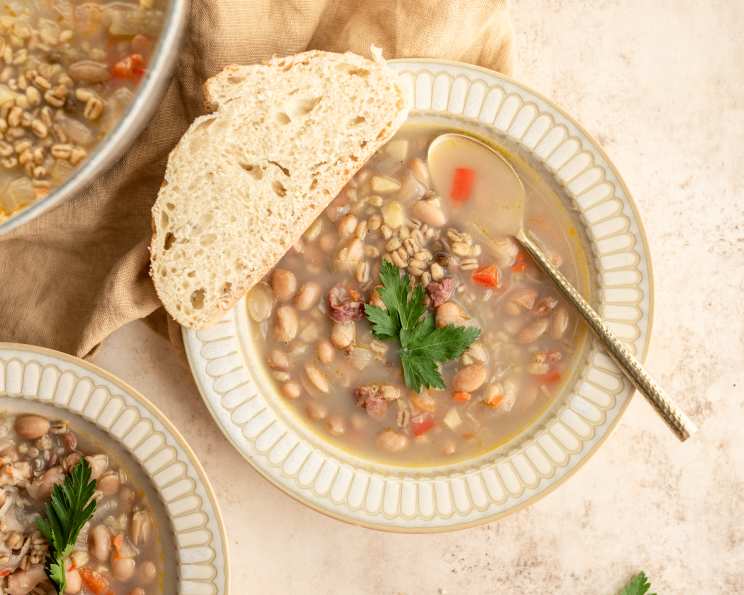
Hearty Bean and Barley Stew: A Taste of Home
The aroma of simmering beans, earthy barley, and savory smoked pork always takes me back to my grandmother’s kitchen. I remember huddling near the stove on chilly afternoons, the rhythmic bubbling of the stew a comforting symphony. She would always let me stir the pot, teaching me the importance of patience and the magic that happens when simple ingredients are given time to meld together. This bean and barley stew is more than just a recipe; it’s a warm hug in a bowl, a taste of tradition passed down through generations.
Recipe Overview
- Prep Time: 24 hours (soaking)
- Cook Time: Approximately 1 hour
- Total Time: 25 hours
- Servings: 6
- Yield: About 8 cups
- Dietary Type: Not Vegetarian
Ingredients
- 450 g dry pinto beans
- 150 g pearl barley
- 2 tablespoons sunflower oil
- 2 onions, chopped (about 250 g)
- 4 garlic cloves, chopped
- 300 g smoked pork necks, diced
- 1 carrot, peeled (150 g)
- 100 g celery root, peeled
- 100 g parsley roots, peeled
- 1 red horn pepper, cut into chunks
- 1 dried bay leaf
- 1 celery leaf
- 1500 ml water
- 1 teaspoon sea salt
- 1 teaspoon ground black pepper
Equipment Needed
- Large pot or Dutch oven
- Blender or food processor (optional)
Instructions
-
Begin by preparing the pinto beans. Place the dry pinto beans in a large bowl and cover them with plenty of water. Let them soak overnight (at least 8 hours). This rehydration step is crucial for even cooking and reducing cooking time. The next day, drain and rinse the soaked beans thoroughly.
-
Next, prepare the pearl barley. Similar to the beans, place the pearl barley in a separate bowl and cover it with plenty of water. Let it soak overnight. The next day, drain and rinse the barley. Cook the barley al dente in a saucepan with double the amount of water (300ml). Once cooked, drain and set aside. Cooking the barley separately ensures it doesn’t become mushy in the stew.
-
In a large pot or Dutch oven, heat the sunflower oil over medium heat. Add the chopped onions and garlic and sauté for about 5 minutes, until they become soft and fragrant. Stir frequently to prevent burning.
-
Add the diced smoked pork neck to the pot. Stir and sauté for another 5 minutes, allowing the pork to brown slightly and release its smoky flavor. This step adds a depth of flavor to the stew.
-
While the onions and pork are sautéing, prepare the mirepoix (a flavorful vegetable base). Traditionally, mirepoix consists of onions, carrots, and celery. This recipe enhances the classic combination with celery root and parsley root, and a piece of red horn pepper. Cut the carrot, celery root, and parsley roots into smaller pieces. You can either finely chop them or use a blender or food processor to coarsely chop them. Add the red horn pepper chunks and pulse the blender once or twice – don’t over-process; you want a slightly chunky texture.
-
Add the prepared mirepoix to the pot with the onions and smoked meat. Stir and cook for 1-2 minutes, allowing the vegetables to soften slightly and release their flavors.
-
Add the drained and rinsed pinto beans, bay leaf, celery leaf, water, and sea salt to the pot. Bring the mixture to a boil.
-
Once boiling, reduce the heat to low, cover the pot, and let the stew simmer gently for 25-30 minutes.
-
Stir in the cooked barley and continue to cook for another 5 minutes, or until the beans are cooked to your desired tenderness (al dente).
-
Season the stew with ground black pepper. Taste and adjust the seasoning as needed.
Expert Tips & Tricks
-
Bean Soaking Secret: For faster cooking, add a pinch of baking soda to the bean soaking water. This helps break down the beans’ outer layer.
-
Smoked Pork Variety: Feel free to experiment with different cuts of smoked pork, such as smoked ham hocks or bacon, to achieve unique flavor profiles. Adjust the cooking time based on the pork’s tenderness.
-
Vegetable Mirepoix: If you don’t have all the root vegetables, you can substitute with other root vegetables like parsnips or turnips.
-
Spice It Up: Add a pinch of red pepper flakes to the mirepoix for a touch of heat.
-
Make-Ahead Tip: This stew tastes even better the next day! Prepare it a day in advance and refrigerate. The flavors will meld together beautifully.
Serving & Storage Suggestions
Serve the bean and barley stew hot, garnished with a sprig of fresh parsley or a drizzle of olive oil. It pairs well with crusty bread for dipping into the flavorful broth.
Storage: Leftover stew can be stored in an airtight container in the refrigerator for up to 3-4 days. For longer storage, freeze the stew in portion-sized containers for up to 2-3 months.
Reheating: Reheat the stew on the stovetop over medium heat or in the microwave until heated through. If the stew has thickened too much during storage, add a little water or broth to thin it out.
Nutritional Information
| Nutrient | Amount per Serving | % Daily Value |
|---|---|---|
| Calories | 316.7 kcal | N/A |
| Calories from Fat | N/A | 22% |
| Total Fat | 7.8 g | 11% |
| Saturated Fat | 1.2 g | 6% |
| Cholesterol | 0 mg | 0% |
| Sodium | 663.4 mg | 27% |
| Total Carbohydrate | 59.4 g | 19% |
| Dietary Fiber | 10.6 g | 42% |
| Sugars | 3.5 g | 13% |
| Protein | 12.8 g | 25% |
Variations & Substitutions
-
Vegetarian Option: Omit the smoked pork neck altogether and substitute it with smoked paprika or a dash of liquid smoke to achieve a smoky flavor. You can also add mushrooms for a heartier texture.
-
Spice Level: Adjust the amount of red horn pepper to control the heat. You can also use a different type of chili pepper if desired.
-
Bean Variety: Experiment with different types of beans, such as kidney beans, cannellini beans, or black beans.
-
Grain Options: While pearl barley is the traditional choice, you can substitute it with other grains like farro or brown rice.
FAQs (Frequently Asked Questions)
Q: Do I really need to soak the beans and barley overnight?
A: Soaking is highly recommended as it significantly reduces cooking time and helps the beans and barley cook more evenly. If you’re short on time, you can try a quick-soak method by boiling the beans and barley for 2 minutes, then letting them sit for an hour before draining and rinsing.
Q: Can I use canned beans instead of dry beans?
A: Yes, you can substitute with canned beans. Use about 6 cups of cooked beans (drained and rinsed) and add them to the stew in the last 15-20 minutes of cooking time. However, the flavor and texture will be slightly different compared to using dried beans.
Q: What is celery root, and where can I find it?
A: Celery root, also known as celeriac, is a root vegetable with a mild celery-like flavor. You can usually find it in the produce section of most well-stocked grocery stores, especially during the fall and winter months.
Q: Can I make this stew in a slow cooker?
A: Absolutely! Sauté the onions, garlic, and smoked pork neck in a skillet before transferring them to the slow cooker. Add all the remaining ingredients (except the cooked barley) and cook on low for 6-8 hours or on high for 3-4 hours. Stir in the cooked barley during the last 30 minutes of cooking time.
Q: How can I thicken the stew if it’s too watery?
A: If the stew is too thin, you can mash some of the beans against the side of the pot to release their starch and thicken the broth. Alternatively, you can mix a tablespoon of cornstarch with a little cold water to create a slurry and then stir it into the stew during the last few minutes of cooking.
Final Thoughts
I truly hope you’ll gather the ingredients and try making this Bean and Barley Stew. It is a deeply satisfying and nourishing meal that will bring warmth and comfort to your table. Feel free to adjust the recipe to your own preferences and available ingredients. I would love to hear your feedback and any creative twists you add to this classic dish. Share your experiences, and most importantly, enjoy the simple pleasure of cooking and sharing good food with loved ones!