
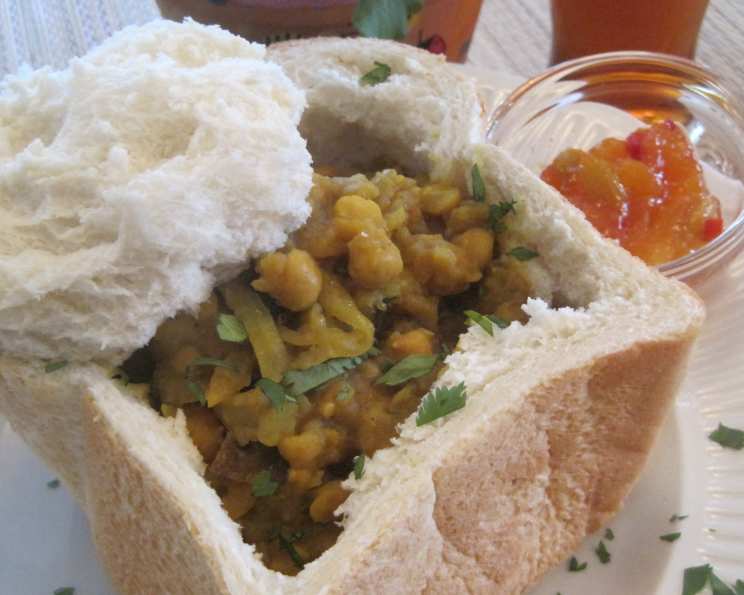
Vegan Bunny Chow: A Taste of Durban in Every Bite
I’ll never forget the first time I tried Bunny Chow. I was backpacking through South Africa, and a local friend insisted I experience this iconic street food. He led me to a bustling market in Durban, the air thick with the aroma of spices and freshly baked bread. The steaming, curry-filled loaf, scooped out and overflowing with flavour, was unlike anything I’d ever tasted. It was messy, intensely aromatic, and utterly delicious – a true explosion of culture and culinary creativity. I’ve been chasing that flavour ever since, and this vegan version brings me right back to that vibrant market.
Recipe Overview
- Prep Time: 15 minutes
- Cook Time: 60 minutes
- Total Time: 1 hour 15 minutes
- Servings: 4
- Yield: 4 Bunny Chows
- Dietary Type: Vegan
Ingredients
- 2 tablespoons vegetable oil
- 1 cinnamon stick
- 4 green cardamom pods, lightly crushed
- 1 medium onion, sliced thinly into rings
- 3 curry leaves
- 4 teaspoons Durban masala (if unavailable, use red curry powder)
- 1 teaspoon ground turmeric
- 1 1⁄2 teaspoons grated ginger
- 1 1⁄2 teaspoons crushed garlic
- 2 large tomatoes, chopped or 2 large 14-oz can chopped tomatoes
- 400 g chickpeas, drained and rinsed
- 4 potatoes, peeled and cubed
- 2 teaspoons garam masala
- Salt, to taste
- 4 crusty square loaves bread (small farmhouse loaves are best)
- Fresh coriander leaves (to garnish)
Equipment Needed
- Large pot or Dutch oven
- Sharp knife
- Chopping board
Instructions
-
Start by heating the vegetable oil in a large pot or Dutch oven over medium heat. Add the cinnamon stick, cardamom pods, onion, and curry leaves. Fry until the onion is golden brown in color, stirring occasionally to prevent burning. This step is crucial for building the flavor base of the curry.
-
Add the Durban masala (or curry powder), turmeric, ginger, and garlic to the pot. Continue to cook over medium heat, stirring frequently, until the mixture begins to resemble a thick puree. This typically takes about 5-7 minutes, allowing the spices to bloom and release their full aroma.
-
Incorporate the chopped tomatoes (fresh or canned) into the spice mixture. Cook, stirring occasionally, until the tomatoes break down and the sauce thickens slightly. This process usually takes around 10 minutes. If using canned tomatoes, ensure they are good quality for the best flavor.
-
Add the drained and rinsed chickpeas to the pot. Cook for approximately 10 minutes, stirring occasionally to allow the chickpeas to absorb the flavors of the sauce.
-
Introduce the peeled and cubed potatoes to the pot. Add about 1/4 cup of water to help create a simmering environment. Reduce the heat to low, cover the pot, and simmer gently. Keep a close eye on the bottom of the pot to ensure the curry doesn’t burn. Add a little more water if necessary.
-
Continue to simmer the curry until the potatoes are tender and easily pierced with a fork. This typically takes around 30 minutes, depending on the size of the potato cubes. Check the potatoes periodically and stir the curry to prevent sticking.
-
Once the potatoes are tender, stir in the garam masala. This adds a final layer of complexity and warmth to the curry.
-
Season the curry to taste with salt. Remember that the bread will also add salt, so start with a small amount and adjust as needed.
-
Simmer the curry for another 10 minutes on low heat, allowing the flavors to meld together. This final simmering period is essential for achieving a well-rounded and harmonious taste.
-
While the curry simmers, prepare the bread. Halve the loaves horizontally and scoop out the centers, leaving the crusts intact to form bowls. Be careful not to puncture the crusts. The scooped-out bread can be used for breadcrumbs or croutons, so don’t discard it!
-
Once the curry is ready, carefully spoon it into the hollowed-out bread halves, filling them generously.
-
Garnish with fresh coriander leaves before serving.
Expert Tips & Tricks
- For a deeper, richer flavor, toast the Durban masala (or curry powder) in a dry pan for a minute or two before adding it to the oil. Be careful not to burn it.
- If you can’t find Durban masala, a good quality red curry powder will work, but the flavor will be slightly different. You can also add a pinch of chili powder for extra heat.
- To make the curry ahead of time, prepare it up to the point of adding the garam masala and salt. Store it in the refrigerator for up to 2 days. When ready to serve, reheat the curry, add the garam masala and salt, and proceed with the recipe.
- For a creamier curry, add a can of coconut milk along with the chickpeas.
- If the curry becomes too thick, add a little more water to achieve the desired consistency.
- Toasting the inside of the bread before filling will prevent it from becoming soggy.
Serving & Storage Suggestions
Serve the Vegan Bunny Chow immediately while the curry is hot and the bread is fresh. Garnish with a generous amount of fresh coriander leaves for a burst of freshness.
Leftover curry can be stored in an airtight container in the refrigerator for up to 3 days. Reheat gently on the stovetop or in the microwave. The bread, however, is best enjoyed fresh and will become soggy if stored with the curry. If you have leftover curry, consider serving it over rice or with roti.
Nutritional Information
| Nutrient | Amount per Serving | % Daily Value |
|---|---|---|
| Calories | 650 kcal | 33% |
| Total Fat | 25g | 38% |
| Saturated Fat | 5g | 25% |
| Cholesterol | 0mg | 0% |
| Sodium | 800mg | 33% |
| Total Carbohydrate | 90g | 30% |
| Dietary Fiber | 20g | 80% |
| Sugars | 10g | – |
| Protein | 25g | 50% |
Nutritional information is an estimate and may vary based on specific ingredients and preparation methods.
Variations & Substitutions
- Gluten-Free: Use gluten-free bread for a gluten-free version.
- Spice Level: Adjust the amount of Durban masala (or curry powder) to control the spice level. Add a pinch of chili flakes for extra heat.
- Vegetables: Feel free to add other vegetables to the curry, such as green beans, carrots, or cauliflower.
- Beans: You can substitute other beans for the chickpeas, such as kidney beans or butter beans.
- Bread: While crusty farmhouse loaves are traditional, you can use any type of bread you prefer. Just make sure it’s sturdy enough to hold the curry.
FAQs (Frequently Asked Questions)
Q: Can I use frozen potatoes?
A: While fresh potatoes are recommended for the best texture, you can use frozen cubed potatoes in a pinch. Just be sure to thaw them slightly before adding them to the curry.
Q: How can I make this spicier?
A: Increase the amount of Durban masala or curry powder, or add a pinch of chili flakes or chopped fresh chilies to the curry.
Q: Can I make this in a slow cooker?
A: Yes, you can adapt this recipe for a slow cooker. Sauté the onions and spices as directed, then transfer everything to the slow cooker and cook on low for 6-8 hours, or on high for 3-4 hours.
Q: What’s the best way to scoop out the bread without tearing it?
A: Use a serrated knife to gently score the inside of the bread, then use a spoon to carefully scoop out the crumb. Leave about a 1-inch border of bread around the crust.
Q: Can I freeze the curry for later?
A: Yes, the curry freezes well. Let it cool completely before transferring it to an airtight container and freezing for up to 3 months. Thaw overnight in the refrigerator before reheating.
Final Thoughts
This Vegan Bunny Chow is more than just a meal; it’s an experience. It’s a taste of South Africa, a celebration of bold flavors and simple ingredients. Don’t be intimidated by the spice list – adjust it to your liking and make it your own. I encourage you to gather your ingredients, invite some friends over, and dive into this delicious and satisfying dish. Share your creations and let me know how it turns out! Consider pairing it with a crisp, cold beer or a refreshing glass of iced tea for the ultimate culinary journey.