
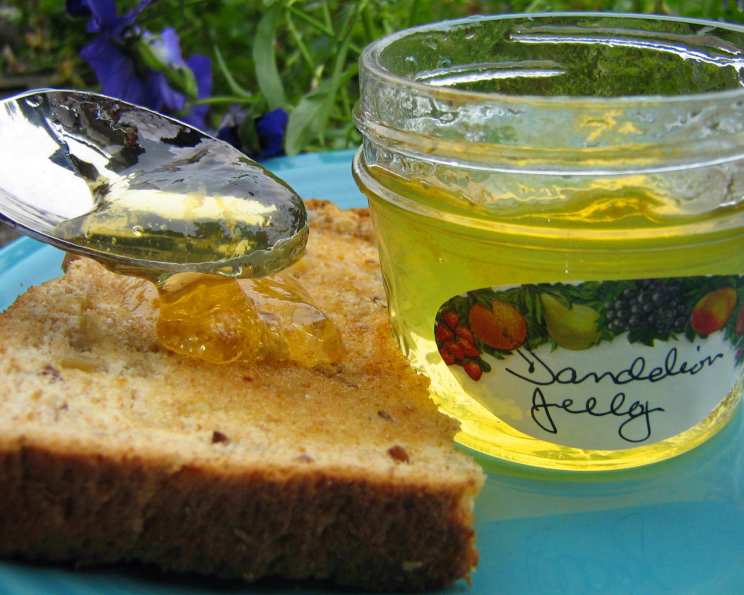
Sunshine in a Jar: The Magic of Dandelion Jelly
As a child, I remember tagging along with my grandmother on her foraging expeditions. While I was mostly interested in chasing butterflies, she had a keen eye for the hidden bounty of nature. One spring, she pointed out a field carpeted in bright yellow dandelions, not as weeds to be scorned, but as a treasure trove of ingredients. We gathered them carefully, and the memory of their sunny fragrance filling her kitchen is something I’ll always cherish. That day, she taught me how to transform these humble flowers into something truly special: Dandelion Jelly. Its unique flavour and beautiful color is a celebration of nature’s simple gifts.
Recipe Overview
- Prep Time: 30 minutes
- Cook Time: 35 minutes
- Total Time: 1 hour 5 minutes
- Yields: 7 half-pint jars
- Dietary Type: Vegetarian, Gluten-Free
Ingredients
- 1 quart of lightly packed fresh organic bright dandelion flowers (try to use only yellow petals discarding the green which I just pinch off)
- 2 tablespoons fresh lemon juice
- 1 lemon, zest of, thinly chopped (optional)
- 5 1/2 cups sugar, or
- 5 1/2 cups lavender sugar with vanilla (Lavender Sugar With Vanilla)
- 1 vanilla bean, split (optional)
- 1 (1 3/4 ounce) package dry pectin
Equipment Needed
- Large stainless steel pan
- Coffee filter
- Deep jelly kettle
- Wooden spoon
- Hot, clean half-pint jelly jars
- Jar lifter
Instructions
- Begin by carefully preparing the dandelion flowers. Pluck the yellow petals from the green parts of the flower heads, as the green parts can impart a bitter flavor to the jelly. This step is crucial for achieving the desired delicate taste.
- In a large stainless steel pan, combine the prepared dandelion flowers with 2 quarts of spring water.
- Bring the mixture to a boil and boil for 10 minutes.
- Remove the pan from the heat and allow the mixture to cool. This steeping process extracts the flavour from the dandelion petals.
- Once cooled, strain the mixture through a fine-mesh sieve, gently pressing the liquid out of the flowers.
- For an even clearer jelly, strain the liquid again through a coffee filter. This removes any remaining sediment and results in a beautifully transparent final product.
- Measure out 3 cups of the strained dandelion liquid.
- Add 2 tablespoons of fresh lemon juice, and the thinly chopped zest of 1 lemon (if using) to the liquid. The lemon juice not only brightens the flavor but also acts as a natural preservative.
- If desired, add 1 split vanilla bean at this stage to infuse the jelly with a subtle vanilla flavour.
- Stir in 1 (1 3/4 ounce) package of dry pectin. Ensure the pectin is fully dissolved before proceeding.
- Transfer the mixture to a deep jelly kettle and bring to a rolling boil over high heat. A rolling boil is a boil that doesn’t stop bubbling even when stirred.
- Add 5 1/2 cups of sugar (or lavender sugar with vanilla) to the boiling mixture. Stir constantly to ensure the sugar dissolves completely.
- Continue stirring and boil hard for 1 1/2 minutes, or until the mixture reaches the setting point. You can test for this by placing a small spoonful of the hot jelly on a chilled plate. If it forms a skin that wrinkles when pushed with your finger, it is ready. This is known as the “sheeting” test.
- Carefully skim off any foam that forms on the surface of the jelly. This will help to create a clearer final product.
- If you added a vanilla bean, carefully remove it from the jelly at this point.
- Immediately pour the hot jelly into hot, clean half-pint jelly jars, leaving 1/4 inch headspace.
- Seal the jars according to the manufacturer’s instructions for your jar type. For water bath canning, process the jars for the recommended time based on your altitude.
- Allow the jars to cool completely on a wire rack. As they cool, you should hear a popping sound as the lids seal.
- Once cooled, check the seals by pressing down on the center of each lid. If the lid doesn’t flex, it is properly sealed.
Note: On May 4, 2010, the recipe was adapted using 6 cups of liquid, 7 cups of sugar, juice of 1 lemon (just over 4 tablespoons), 1/2 teaspoon vanilla and 1 1.75oz(49)grams of pectin, yielding 9 1/2 pint jars.
Expert Tips & Tricks
- Timing is key: Once the sugar is added, the jelly-making process moves quickly. Have your jars ready and sterilized beforehand.
- Use a candy thermometer: While the sheeting test is reliable, a candy thermometer can help you achieve a more consistent set. Aim for 220°F (104°C).
- Prevent crystallization: Ensure all sugar crystals are fully dissolved during the boiling process. Adding a small amount of corn syrup (about a tablespoon) can also help prevent crystallization.
- Sun Tea Method: For a gentler extraction, try the sun tea approach. Place the flowers in a large jar, add 3 cups of hot water, and place in the sun (or leave at room temperature) for 24 hours. Strain and proceed with the recipe.
- Infuse with Herbs: Consider adding other herbs like rosemary or thyme during the boiling process for a more complex flavour profile. Remove the herbs before pouring into jars.
Serving & Storage Suggestions
Dandelion Jelly is delicious served with scones, toast, or crackers. It also makes a wonderful glaze for meats or poultry. Its delicate flavour pairs well with creamy cheeses like brie or goat cheese.
Store sealed jars of Dandelion Jelly in a cool, dark place for up to 1 year. Once opened, refrigerate and use within a few weeks. Unsealed jars should be refrigerated immediately and used within a week. Properly canned and stored dandelion jelly will be shelf-stable.
Nutritional Information
Please note that these values are estimates and can vary based on specific ingredients and preparation methods.
| Nutrient | Amount per Serving | % Daily Value* |
|---|---|---|
| Calories | 158 kcal | 8% |
| Total Fat | 0g | 0% |
| Saturated Fat | 0g | 0% |
| Cholesterol | 0mg | 0% |
| Sodium | 4mg | 0% |
| Total Carbohydrate | 40g | 15% |
| Dietary Fiber | 0g | 0% |
| Sugars | 39g | N/A |
| Protein | 0g | 0% |
*Percent Daily Values are based on a 2,000 calorie diet.
Variations & Substitutions
- Honey Instead of Sugar: Substitute honey for all or part of the sugar. This will change the flavour profile slightly, but it can add a lovely depth.
- Different Citrus: Experiment with different citrus fruits, such as orange or grapefruit, in place of the lemon.
- Spiced Dandelion Jelly: Add warming spices like cinnamon, cloves, or nutmeg during the boiling process for a festive twist. Use sparingly to avoid overpowering the delicate dandelion flavour.
- Floral Infusion: Add other edible flowers like violets or pansies to the dandelion mixture for a more complex floral flavour.
- Spicy Jelly: Add a pinch of red pepper flakes for a sweet and spicy jelly.
FAQs (Frequently Asked Questions)
Q: Can I use frozen dandelion flowers?
A: Fresh dandelion flowers are best, but you can use frozen if necessary. Be sure to thaw them completely and drain any excess liquid before using.
Q: How do I sterilize my jelly jars?
A: Sterilize jars by boiling them in water for 10 minutes. Keep them hot until ready to fill with jelly. You can also sterilize them in a dishwasher on the sanitize cycle.
Q: Why is my jelly not setting?
A: Several factors can prevent jelly from setting, including insufficient pectin, too little sugar, or undercooking. Make sure to follow the recipe precisely and test for the sheeting point.
Q: Can I reduce the amount of sugar in this recipe?
A: Sugar is crucial for both the flavour and the setting of the jelly. Reducing the sugar significantly can result in a runny jelly. If you want to reduce the sugar, you may need to use a low-sugar pectin.
Q: How long will the Dandelion Jelly last?
A: When properly canned, the jelly should last for up to one year when stored in a cool, dark place. Once opened, refrigerate and use within a few weeks.
Final Thoughts
Making Dandelion Jelly is a truly rewarding experience, a connection to nature’s simple beauty. The process of gathering the flowers, extracting their essence, and transforming them into a golden, flavourful spread is something special. I hope this recipe inspires you to try your hand at this unique preserve. Don’t hesitate to experiment with the variations and make it your own. Share your creations and experiences – I’d love to hear about your sunny adventures in jelly-making! Perhaps pair it with some homemade scones and a cup of tea for the ultimate afternoon treat. Happy cooking!