
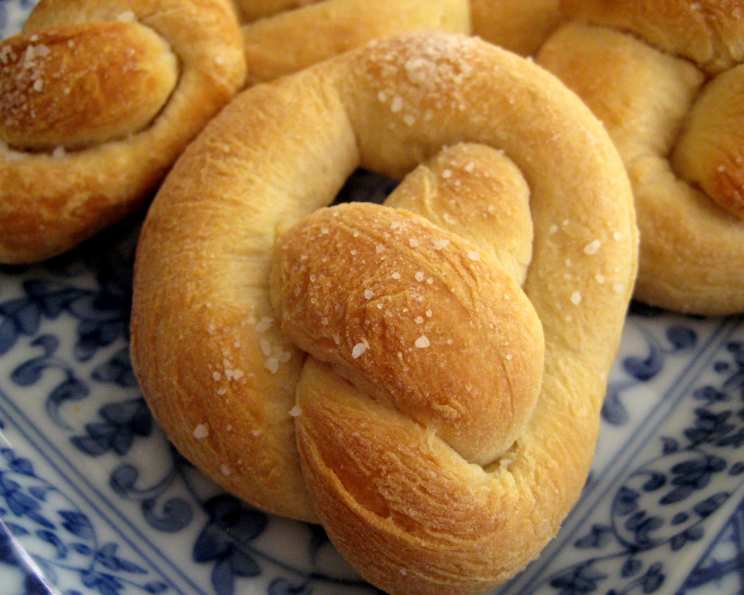
Authentic German Pretzels: A Taste of Tradition
The scent of warm pretzels baking instantly transports me back to the bustling Christmas markets of Germany. I remember, bundled in a thick scarf, watching the pretzel makers expertly twist dough into that familiar shape, the air thick with the aroma of baking bread and wood smoke. The first bite, that slightly chewy crust giving way to a soft, yielding interior, was pure comfort. It’s a memory I cherish, and one I’m excited to share with you through this recipe.
Recipe Overview
- Prep Time: 45 minutes (including shaping)
- Rise Time: 2 hours 15 minutes – 2 hours 45 minutes (two rises)
- Cook Time: 10-15 minutes
- Total Time: 3 hours 10 minutes – 3 hours 40 minutes
- Yields: 12 pretzels
- Serves: 12
- Dietary Type: Vegetarian
Ingredients
- 1 (1/4 ounce) package active dry yeast
- 1 1/2 cups warm water
- 1/8 teaspoon salt
- 1 tablespoon granulated sugar
- 4 cups unbleached flour
- 1 egg
- 1 teaspoon coarse salt
Equipment Needed
- Medium bowl
- Cookie sheets
- Pastry brush
Instructions
- In a medium bowl, dissolve the yeast in the warm water. Make sure the water isn’t too hot, or it will kill the yeast. It should be comfortably warm to the touch, around 105-115°F (40-46°C).
- Add the salt and sugar to the yeast mixture, and stir to dissolve. The sugar provides food for the yeast, helping it to activate and create those lovely air pockets that make pretzels so airy.
- Blend in the flour. It’s best to add the flour gradually, mixing as you go, until a shaggy dough forms.
- Knead the dough until smooth, about 7 or 8 minutes. You can do this by hand on a lightly floured surface or using a stand mixer with a dough hook. The dough should be elastic and slightly tacky, but not sticky.
- Cover the bowl with a clean kitchen towel or plastic wrap and let the dough rise for 1 to 1 1/4 hours or until double in bulk. Find a warm place, free from drafts, to encourage rising.
- Grease several cookie sheets to prevent the pretzels from sticking.
- Punch the dough down to release the air. This helps create a more even texture in the final product.
- Cut the dough into 12 equal pieces. Using a kitchen scale is helpful for ensuring even portions.
- Slightly beat the egg in a small bowl and set aside. This will be used for the egg wash, giving the pretzels a beautiful golden-brown color.
- Roll each piece of dough into a thin rope about as round as your little finger (approximately 1/2 inch). This takes a bit of practice. Aim for a uniform thickness along the entire length of the rope.
- Twist each rope into pretzel shapes before placing them on a greased cookie sheet. There are many tutorials online showing how to shape pretzels, but the classic shape is formed by making a loop, crossing the ends, and pressing them onto the bottom of the loop.
- Using a pastry brush, coat the top of each pretzel with the beaten egg. Be sure to get an even coating for consistent browning.
- Sprinkle the pretzels with coarse salt. Feel free to use pretzel salt or kosher salt.
- Allow the pretzels to rise again until almost double in bulk, about 1 hour. This second rise is important for creating a light and airy texture.
- Preheat the oven to 425 degrees F (220 degrees C).
- Bake the pretzels for 10 to 15 minutes, or until browned. Keep a close eye on them; oven times may vary. You’re looking for a deep golden-brown color.
- Cool slightly before serving.
Expert Tips & Tricks
- The lye bath: Authentic German pretzels are traditionally dipped in a lye solution before baking, which gives them their characteristic dark brown color and slightly chewy crust. This recipe omits the lye bath for simplicity and safety, but you can explore food-grade lye if you’re feeling adventurous.
- Proofing the yeast: Always check the expiration date on your yeast and proof it before using it. To proof yeast, add it to warm water with a pinch of sugar. If it foams up after 5-10 minutes, it’s good to go.
- Kneading the dough: Proper kneading is essential for developing the gluten, which gives the pretzels their structure. If you’re kneading by hand, use a strong, rhythmic motion, pushing the dough away from you with the heel of your hand, then folding it back on itself.
- Shaping the pretzels: Don’t be discouraged if your first few pretzels aren’t perfect. It takes practice to get the hang of the twisting technique. Watch some online tutorials for visual guidance.
- Even baking: To ensure even baking, rotate the cookie sheets halfway through the baking time.
Serving & Storage Suggestions
These pretzels are best enjoyed warm, straight from the oven. Serve them with your favorite mustard, cheese sauce, or Obatzda (a Bavarian cheese spread). They can also be used to make delicious sandwiches.
Leftover pretzels can be stored in an airtight container at room temperature for 1-2 days. For longer storage, freeze them for up to 2 months. To reheat, thaw them completely and then warm them in a preheated oven at 350°F (175°C) for 5-10 minutes.
Nutritional Information
| Nutrient | Amount per Serving | % Daily Value |
|---|---|---|
| Calories | 163.6 kcal | N/A |
| Calories from Fat | 7 g | N/A |
| Total Fat | 0.8 g | 1% |
| Saturated Fat | 0.2 g | 1% |
| Cholesterol | 15.5 mg | 5% |
| Sodium | 226 mg | 9% |
| Total Carbohydrate | 33.1 g | 11% |
| Dietary Fiber | 1.3 g | 5% |
| Sugars | 1.2 g | 4% |
| Protein | 5.1 g | 10% |
Variations & Substitutions
- Whole wheat pretzels: Substitute up to half of the unbleached flour with whole wheat flour for a nuttier flavor and added fiber.
- Sweet pretzels: Sprinkle the pretzels with cinnamon sugar instead of coarse salt for a sweet treat.
- Gluten-free pretzels: Use a gluten-free flour blend designed for bread baking. You may need to adjust the amount of liquid depending on the flour blend you use.
- Herb pretzels: Add dried herbs such as rosemary, thyme, or oregano to the dough for a savory twist.
- Cheese pretzels: Sprinkle the pretzels with shredded cheese during the last few minutes of baking.
FAQs (Frequently Asked Questions)
Q: Can I make the dough ahead of time?
A: Yes, you can prepare the dough ahead of time. After the first rise, punch it down, wrap it tightly in plastic wrap, and refrigerate it for up to 24 hours. Let it come to room temperature before shaping and baking.
Q: Why are my pretzels tough?
A: Over-kneading the dough or baking the pretzels for too long can result in a tough texture. Be sure to knead the dough just until smooth and bake them until golden brown, but not hard.
Q: Can I freeze the baked pretzels?
A: Yes, baked pretzels freeze well. Let them cool completely, then wrap them individually in plastic wrap and place them in a freezer bag. They can be stored in the freezer for up to 2 months.
Q: What can I use instead of coarse salt?
A: If you don’t have coarse salt, you can use kosher salt, sea salt flakes, or even pretzel salt.
Q: Why didn’t my pretzels rise properly?
A: Several factors can affect rising, including using expired yeast, water that is too hot or too cold, or a cold environment. Make sure your yeast is fresh, your water is at the correct temperature, and your dough is in a warm place to rise.
Final Thoughts
There’s a certain magic in baking bread, a simple alchemy that transforms humble ingredients into something truly special. These German pretzels are more than just a snack; they’re a connection to tradition, a taste of comfort, and a reminder of shared moments. I hope you’ll give this recipe a try and create your own pretzel memories. Don’t hesitate to experiment with different flavors and toppings. And if you have any questions or feedback, please share them in the comments below. Guten Appetit!