
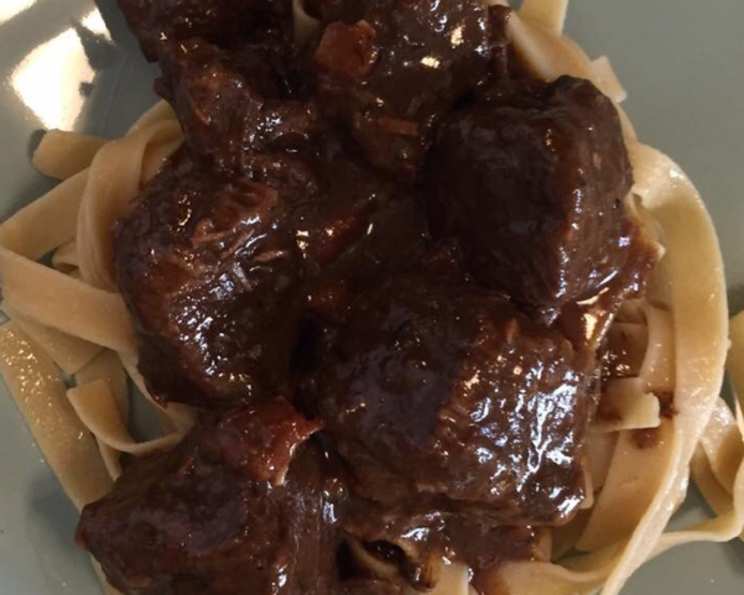
Savory Simplicity: A Taste of Hungarian Goulash with Red Wine
The aroma alone transports me back to a cozy evening in Budapest. Twirling strings of buttered noodles around my fork, the deep, savory scent of paprika and beef filled the air. I remember a bustling little “csárda” (Hungarian tavern), filled with the warmth of laughter and the clinking of glasses. Each spoonful of that rich goulash was a comforting hug, a taste of history and home. This recipe, adapted from a friend’s family tradition, seeks to recreate that unforgettable experience.
Recipe Overview
- Prep Time: 20 minutes
- Cook Time: 1 hour 45 minutes – 2 hours 15 minutes
- Total Time: 2 hours 5 minutes – 2 hours 35 minutes
- Servings: 6
- Yield: About 8 cups
- Dietary Type: Generally Dairy-Free (can be modified to include sour cream)
Ingredients
- 2 – 3 lbs stewing beef, cut into cubes
- 1/2 cup bacon, cut into small pieces
- 1/2 teaspoon salt
- 1/4 teaspoon black pepper
- 2 tablespoons sweet Hungarian paprika
- 1 tablespoon caraway seed (less if you prefer a milder flavor)
- 1 bay leaf
- 1 – 2 green peppers or 1 – 2 red peppers, cut into 1-inch pieces
- 1 1/2 cups beef stock (or water with stock cubes according to package directions)
- 1 1/2 cups dry red wine (a full-bodied wine is best; if omitting wine, increase stock and add a splash of red wine vinegar)
- 3 – 4 cloves garlic, minced or cut into small pieces
- 1 large onion, cut small
- Some sour cream, if you like it creamier (optional)
- 1/2 teaspoon hot paprika, if you like it hot (optional)
Equipment Needed
- Deep pan or Dutch oven
- Knife
- Cutting board
- Measuring cups and spoons
Instructions
-
Begin by preparing the foundation of the dish. In a deep pan or Dutch oven, fry the 1/2 cup of bacon pieces for several minutes, until the fat is rendered and the bacon is crisp. This flavorful bacon fat will be crucial for browning the beef and infusing the goulash with savory depth.
-
Next, introduce the stewing beef. Add the 2-3 lbs of beef cubes to the pan with the bacon and rendered fat. Brown the beef on all sides, stirring frequently, until nicely seared. This step develops a rich, caramelized flavor that’s essential to a good goulash. Don’t overcrowd the pan; work in batches if necessary to ensure proper browning.
-
Now, add the aromatics. Add the 1 large onion, cut small, and the 3-4 cloves of garlic, minced or cut into small pieces, to the pan. Brown them, stirring occasionally, until softened and fragrant. Be careful not to burn the garlic, as this will impart a bitter taste.
-
Stir in the peppers and paprika. Add the 1-2 green or red peppers, cut into 1-inch pieces, and the 2 tablespoons of sweet Hungarian paprika (and 1/2 teaspoon hot paprika, if using) to the pan. Stir well to coat the ingredients with the paprika. The paprika not only adds flavor but also contributes to the goulash’s signature reddish hue.
-
Time to simmer. Add the remaining ingredients: 1 tablespoon caraway seed, 1/2 teaspoon salt, 1/4 teaspoon black pepper, 1 bay leaf, 1 1/2 cups beef stock, and 1 1/2 cups dry red wine. Stir everything together to combine. If you’re using water and stock cubes, ensure the stock cubes are fully dissolved.
-
Cover the pan and cook on low heat for 1 1/2 – 2 hours, or until the beef is tender. Check the goulash periodically, and add more water or beef stock if needed to maintain the desired consistency. If the goulash is too thin at the end of the cooking time, remove the cover and allow some of the excess liquid to evaporate.
-
Before serving, remove the bay leaf. This prevents anyone from accidentally biting into it.
-
For a creamier texture, add a dollop of sour cream to the goulash just before serving. This is optional, but it adds a lovely richness and tanginess.
-
Serve the goulash hot with buttered noodles or bread dumplings, according to preference.
Expert Tips & Tricks
- Browning is key: Don’t rush the browning of the beef and onions. This step develops layers of flavor that are crucial to the final dish.
- Paprika matters: Use high-quality Hungarian paprika for the best flavor and color. There are different grades of paprika; “sweet” paprika is the most common.
- Wine substitution: If you don’t have red wine, you can substitute additional beef stock and a tablespoon of red wine vinegar.
- Spice adjustment: Adjust the amount of hot paprika to your preference. Start with a small amount and add more to taste.
- Thickening: If the goulash is too thin after cooking, you can thicken it by mixing a tablespoon of cornstarch with a tablespoon of cold water to form a slurry, then stirring it into the goulash and cooking for a few minutes until thickened.
- Make ahead: Goulash tastes even better the next day! Make it a day in advance and reheat it before serving.
Serving & Storage Suggestions
Serve the Hungarian Goulash hot in bowls, garnished with a dollop of sour cream (optional) and a sprinkle of fresh parsley (if desired). It pairs wonderfully with buttered egg noodles, spaetzle, or crusty bread for soaking up the flavorful sauce.
Leftover goulash can be stored in an airtight container in the refrigerator for up to 3-4 days. It can also be frozen for up to 2-3 months. Thaw frozen goulash overnight in the refrigerator before reheating. Reheat gently in a saucepan over medium heat, stirring occasionally, until heated through. You may need to add a splash of water or beef stock if the goulash has thickened during storage. Avoid leaving the goulash at room temperature for more than two hours.
Nutritional Information
| Nutrient | Amount per Serving | % Daily Value |
|---|---|---|
| Calories | 329 kcal | N/A |
| Calories from Fat | 115 g | 35% |
| Total Fat | 12.8 g | 19% |
| Saturated Fat | 4.9 g | 24% |
| Cholesterol | 104.9 mg | 34% |
| Sodium | 643.9 mg | 26% |
| Total Carbohydrate | 7.5 g | 2% |
| Dietary Fiber | 2 g | 8% |
| Sugars | 2.2 g | N/A |
| Protein | 36.1 g | 72% |
Note: Nutritional information is an estimate and may vary based on specific ingredients and portion sizes.
Variations & Substitutions
- Vegetarian Goulash: Substitute the beef with mushrooms and lentils for a hearty vegetarian version.
- Spicy Goulash: Add more hot paprika or a pinch of cayenne pepper for extra heat.
- Smoked Paprika: Use smoked paprika instead of sweet paprika for a smoky flavor.
- Root Vegetables: Add diced carrots, parsnips, or potatoes to the goulash for added heartiness and sweetness.
- Beer Goulash: Substitute the red wine with a dark beer for a richer, maltier flavor.
FAQs (Frequently Asked Questions)
Q: Can I make this in a slow cooker?
A: Yes, you can adapt this recipe for a slow cooker. Brown the beef and onions as directed in the recipe, then transfer everything to a slow cooker and cook on low for 6-8 hours, or on high for 3-4 hours.
Q: How do I know when the beef is tender enough?
A: The beef is tender enough when it can be easily pierced with a fork and falls apart easily.
Q: Can I use a different cut of beef?
A: While stewing beef is ideal, you can use other cuts like chuck roast or brisket. Just be sure to cook it long enough for the meat to become tender.
Q: Can I add other vegetables?
A: Absolutely! Carrots, potatoes, and parsnips are all great additions to goulash. Add them during the last hour of cooking.
Q: Can I freeze leftover goulash?
A: Yes, goulash freezes well. Store it in an airtight container for up to 2-3 months. Thaw it overnight in the refrigerator before reheating.
Final Thoughts
Hungarian Goulash is more than just a stew; it’s a culinary journey into the heart of Central Europe. With its rich flavors, tender beef, and warming spices, it’s the perfect comfort food for a chilly evening. Don’t be afraid to experiment with the recipe and make it your own. Whether you follow the recipe to the letter or add your personal touch, I hope this dish brings you as much joy as it has brought me. Pair it with a crisp, dry white wine like a Grüner Veltliner or a hearty red wine such as a Cabernet Franc. Enjoy, and jó étvágyat!