
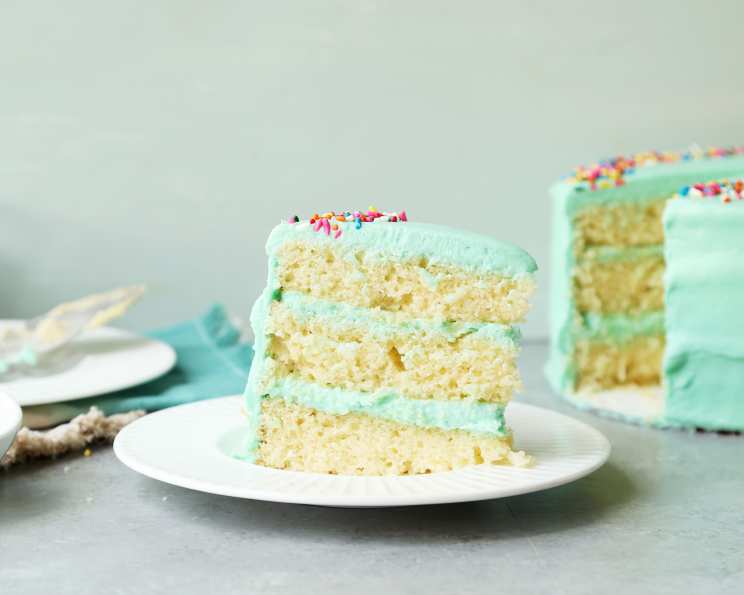
Magnolia Bakery’s Vanilla Birthday Cake: A Slice of Nostalgia
There’s something about a simple vanilla cake, especially one slathered in pastel buttercream and confetti sprinkles, that can transport you right back to childhood. I remember my own seventh birthday party vividly, the air thick with the smell of balloons and sugary frosting, the taste of a similar cake exploding with sweetness on my tongue. It wasn’t just dessert; it was a moment suspended in time, a pure distillation of joy. Recreating Magnolia Bakery’s version of this classic is like holding a piece of that memory, a reminder that the simplest things are often the most profound.
Recipe Overview:
- Prep Time: 20 minutes
- Cook Time: 25 minutes
- Total Time: 45 minutes
- Yields: One 3-layer cake
- Serves: 16
- Dietary Type: Not specified
Ingredients:
For the Cake Batter:
- 1 cup (2 sticks) unsalted butter, softened
- 2 cups sugar
- 4 large eggs, at room temperature
- 1 ½ cups self-rising flour
- 1 ¼ cups all-purpose flour
- 1 cup milk
- 1 teaspoon vanilla extract
For the Buttercream Frosting:
- 1 cup (2 sticks) unsalted butter, very soft
- 8 cups confectioners’ sugar
- ½ cup milk
- 2 teaspoons vanilla extract
Equipment Needed:
- Electric mixer (stand or hand-held)
- Three 9-inch round cake pans
- Parchment paper
- Measuring cups and spoons
- Mixing bowls
- Wire rack
- Rubber spatula or offset spatula
Instructions:
- Preheat your oven to 350°F (175°C). This ensures even baking.
- Prepare your cake pans. Grease and lightly flour three 9-inch round cake pans. Cut circles of waxed paper (or parchment paper) to fit the bottoms of the pans and place them inside. This prevents the cakes from sticking and makes for easy removal.
- Cream the butter. In a large bowl, using the medium speed of an electric mixer, cream the softened butter until it is smooth. This step incorporates air, which is essential for a light and fluffy cake.
- Add the sugar gradually. Slowly add the sugar to the creamed butter, beating until the mixture is light and fluffy. This should take about 3 minutes. The mixture should lighten in color and increase in volume.
- Incorporate the eggs. Add the eggs one at a time, beating well after each addition. It’s crucial to fully incorporate each egg before adding the next to prevent the batter from curdling. Room temperature eggs emulsify better, resulting in a smoother batter.
- Combine dry and wet ingredients. In a separate bowl, combine the self-rising flour and all-purpose flour. Then, add the flour mixture to the butter mixture in four parts, alternating with the milk and vanilla extract, beating well after each addition. Begin and end with the flour mixture. This method prevents the gluten in the flour from developing too much, resulting in a tender cake. Be careful not to overmix at this stage, as overmixing can lead to a tough cake.
- Divide the batter evenly. Divide the batter evenly among the prepared cake pans. An easy way to do this is to use a kitchen scale to weigh each pan, ensuring they have roughly the same amount of batter.
- Bake the cakes. Bake for 20 to 25 minutes, or until a cake tester (or toothpick) inserted into the center of each cake comes out clean. The cakes should be golden brown on top and spring back lightly when touched.
- Cool the cakes. Let the cakes cool in the pans for 10 minutes before inverting them onto a wire rack to cool completely. This prevents them from breaking apart while still warm.
- Prepare the cupcakes (if making cupcakes). Line two 12-cup muffin tins with cupcake papers. Spoon the batter into the cups, filling them about three-quarters full. Bake until the tops spring back when lightly touched, about 20 to 22 minutes. Remove cupcakes from pans and cool completely on a rack before icing.
- Make the buttercream frosting. Place the butter in a large mixing bowl. Add 4 cups of the confectioners’ sugar, then add the milk and vanilla extract. Beat until smooth and creamy.
- Adjust the frosting consistency. Gradually add the remaining confectioners’ sugar, 1 cup at a time, until the icing is thick enough to be of good spreading consistency. You may not need all of the sugar, so adjust accordingly. If the frosting is too thick, add a little more milk, one tablespoon at a time. If it’s too thin, add more confectioners’ sugar, a quarter cup at a time.
- Color the frosting (optional). If desired, add a few drops of food coloring and mix thoroughly. Gel food coloring is best, as it doesn’t add excess liquid to the frosting.
- Assemble the cake. Once the cakes have cooled completely, ice between the layers and then ice the top and sides of the cake. Use a spatula or an offset spatula for smooth, even coverage. Decorate with your favorite sprinkles!
- Store and use the frosting at room temperature. The icing will set if chilled, so it’s best to use and store it at room temperature. You can store any leftover frosting in an airtight container for up to three days.
Expert Tips & Tricks:
- Room temperature ingredients are key! Ensure that your butter, eggs, and milk are at room temperature for optimal emulsification and a smooth batter.
- Don’t overmix the batter. Overmixing develops gluten, leading to a tough cake. Mix until just combined.
- Level your cake layers. If your cake layers are uneven, use a serrated knife to trim the tops for a perfectly flat surface.
- Chill the cake layers before frosting. This will make them easier to handle and prevent the frosting from melting.
- Make a crumb coat. Apply a thin layer of frosting to the cake, then chill for 15-20 minutes before applying the final layer of frosting. This traps any loose crumbs and prevents them from getting into your final frosting layer.
- Use a turntable. A turntable makes it much easier to frost a cake evenly.
Serving & Storage Suggestions:
Serve the Magnolia Bakery’s Vanilla Birthday Cake at room temperature. Slice and enjoy! To store leftovers, cover the cake tightly with plastic wrap or place it in an airtight container. It will keep at room temperature for up to 2 days or in the refrigerator for up to 5 days. For longer storage, you can freeze the cake (frosted or unfrosted) for up to 2 months. Thaw it in the refrigerator overnight before serving.
Nutritional Information:
| Nutrient | Amount per Serving | % Daily Value |
|---|---|---|
| Calories | 645 kcal | N/A |
| Calories from Fat | 227 g | 35% |
| Total Fat | 25.2 g | 38% |
| Saturated Fat | 15.5 g | 77% |
| Cholesterol | 110.7 mg | 36% |
| Sodium | 182.6 mg | 7% |
| Total Carbohydrate | 102.3 g | 34% |
| Dietary Fiber | 0.6 g | 2% |
| Sugars | 83.8 g | 335% |
| Protein | 4.7 g | 9% |
Please note that these values are estimates and can vary based on specific ingredients and portion sizes.
Variations & Substitutions:
- Gluten-Free: Substitute the all-purpose and self-rising flours with a gluten-free flour blend. Be sure to add a binder like xanthan gum to improve the texture.
- Dairy-Free: Replace the butter with a dairy-free butter alternative and the milk with a dairy-free milk alternative like almond or soy milk.
- Lemon Vanilla Cake: Add the zest of one lemon to the cake batter for a bright citrus flavor.
- Chocolate Frosting: Replace the vanilla extract in the buttercream frosting with 1/2 cup of cocoa powder for a chocolate twist.
- Funfetti Cake: Add 1/2 cup of rainbow sprinkles to the cake batter for a festive funfetti cake.
FAQs (Frequently Asked Questions):
Q: Can I make this cake ahead of time?
A: Yes, you can bake the cake layers a day or two in advance. Wrap them tightly in plastic wrap and store them at room temperature or in the refrigerator. You can also make the frosting ahead of time and store it in an airtight container in the refrigerator for up to 3 days. Let it come to room temperature before using.
Q: My frosting is too thin. What should I do?
A: Gradually add more confectioners’ sugar, a quarter cup at a time, until the frosting reaches the desired consistency.
Q: My frosting is too thick. What should I do?
A: Add a little more milk, one tablespoon at a time, until the frosting reaches the desired consistency.
Q: Can I use salted butter instead of unsalted butter?
A: While you can, unsalted butter is recommended for more control over the salt content of the cake and frosting. If you use salted butter, you may want to reduce the amount of salt in the recipe slightly.
Q: How do I prevent the cake from sticking to the pan?
A: Grease and flour the cake pans thoroughly, and line the bottoms with parchment paper. This will ensure that the cakes release easily from the pans.
Final Thoughts:
This Magnolia Bakery Vanilla Birthday Cake is more than just a recipe; it’s an invitation to create joyful memories. Don your apron, gather your ingredients, and let the aroma of vanilla fill your kitchen. Don’t be afraid to get creative with sprinkles and decorations. Whether you’re celebrating a birthday, a special occasion, or simply craving a sweet treat, this cake is sure to bring a smile to your face. And if you try it, don’t forget to share your creation and tag us in your photos. Happy baking!