
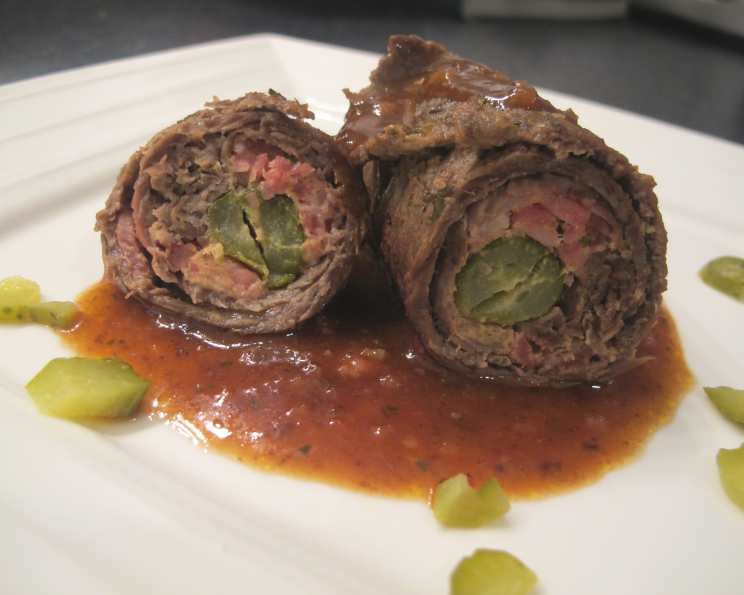
Mom’s Traditional German Beef Rouladen (Rinderrouladen)
The scent alone transports me back to childhood Sundays, the comforting aroma of simmering beef mingling with the sweet and sour notes of braised red cabbage. I remember perched on a stool in Mom’s kitchen, watching her expertly roll each thin steak around its savory filling, a practiced hand securing it with toothpicks. It wasn’t just a meal; it was an act of love, a tradition passed down through generations, and the taste of home itself.
Recipe Overview
- Prep Time: 45 minutes
- Cook Time: 1 hour 45 minutes
- Total Time: 2 hours 30 minutes
- Servings: 8
- Yield: 8 Rouladen
- Dietary Type: Omnivore
Ingredients
- 2 ½ lbs lean high-quality beef round steak, cut into 8 equal rectangular sections and pounded flat
- 8 tablespoons yellow mustard
- Salt and pepper, to taste
- 4 slices bacon, chopped
- ½ cup white onion, chopped
- ¼ cup dill pickle, finely chopped (may use dill relish)
- ¼ cup oil, for frying
- 3 ½ cups hot water, to cover (or hot beef broth)
- 1 bay leaf
- ⅓ cup flour
- ¼ cup fresh parsley, minced (for serving)
- Wooden toothpicks (or may use cooking twine or white thread for securing rouladen)
Equipment Needed
- Large cutting board
- Meat mallet or rolling pin
- Large bowl
- Large Dutch oven or heavy-bottomed pot with lid
- Slotted spoon
- Oven-proof dish
- Aluminum foil
- Measuring cups and spoons
- Whisk
Instructions
- On a clean cutting board, lay out the pounded beef steaks.
- Spread 1 tablespoon of yellow mustard evenly on one side of each pounded steak. Be sure to cover the entire surface for maximum flavor.
- Generously sprinkle salt and pepper over the mustard-covered side of each steak. Don’t be shy; this is your chance to season the beef directly.
- Evenly distribute the chopped bacon, onion, and dill pickle (or relish) over the mustard side of each steak. Aim for a uniform layer to ensure consistent flavor in every bite.
- Now, for the rolling! Roll up each steak firmly, jelly-roll fashion, with the filling to the inside. Start at the narrow end of the steak and roll tightly to create a compact rouladen.
- Secure each rouladen shut with wooden toothpicks, cooking twine, or white sewing thread. Place the toothpicks or twine close together to prevent the filling from escaping during cooking. If using thread, wrap it tightly around the rouladen several times and knot securely.
- In a large Dutch oven or heavy-bottomed pot, heat the cooking oil over medium-high heat. The oil should shimmer but not smoke.
- When the oil is hot, carefully add the rouladen rolls to the pot. Be careful not to overcrowd the pot; work in batches if necessary.
- Fry the rouladen until nicely browned on all sides, turning once or twice to ensure even browning. This will take about 7 minutes per side. This step is crucial for developing rich, complex flavors in the finished dish.
- Add enough hot water (or hot beef broth) to the pot to almost cover the rouladen. The liquid should come up to about three-quarters of the way up the sides of the rolls.
- Add the bay leaf to the pot.
- Increase the heat to high and bring the liquid to a boil.
- Once boiling, cover the pot tightly with a lid and reduce the heat to low.
- Simmer, covered, for 1 ½ hours on low heat.
- Check the rouladen halfway through cooking to ensure they are still covered with sufficient liquid. If necessary, add a little more hot water or broth at this point. Gently stir the pot to prevent sticking.
- After 1 ½ hours, carefully remove the rouladen from the hot broth using a large slotted spoon.
- Transfer the rouladen to an oven-proof dish, cover with aluminum foil, and keep warm in a preheated oven (at the lowest setting, around 200°F or 95°C) while you prepare the gravy. This will prevent the rouladen from drying out.
- To make the gravy, add the flour to 1 cup of water in a large measuring cup.
- Whisk the flour and water mixture briskly with a fork to blend until smooth, ensuring no lumps remain.
- Pour the flour mixture all at once into the hot broth in the Dutch oven, using a wire whisk to blend it in.
- Use a wooden spoon to scrape up any browned bits from the bottom of the pan and stir them into the gravy. These browned bits are packed with flavor and will add depth to the gravy.
- Increase the heat to medium-high and bring the gravy mixture to a boil, whisking constantly to prevent lumps from forming.
- Continue to whisk and boil the gravy for two to three minutes, until it thickens to your desired consistency.
- Reduce the heat to low and remove the bay leaf from the gravy.
- Adjust the seasoning of the gravy to taste with salt and pepper.
- Remove the toothpicks, cooking twine or thread from the rouladen before serving.
- Using a large slotted spoon, carefully place the rouladen back into the hot gravy.
- Cover the pot and warm the rouladen through for a few minutes in the gravy.
- Remove from heat and serve hot. Traditionally served with boiled new potatoes or potato dumplings sprinkled with fresh snipped parsley, and German Rotkohl (Red Cabbage) or Country Green Beans with Bacon and Onion.
Expert Tips & Tricks
- Pounding the Beef: Don’t skip the pounding step! It tenderizes the meat and allows it to be rolled easily. If you don’t have a meat mallet, a rolling pin works well. Place the steak between two sheets of plastic wrap to prevent tearing.
- Browning is Key: Take your time browning the rouladen. A good sear creates a deep, savory flavor that permeates the entire dish.
- Gravy Consistency: For a richer gravy, add a tablespoon of tomato paste along with the flour slurry. If the gravy is too thin, simmer it for a few more minutes, whisking occasionally, until it thickens. If it’s too thick, add a little more broth or water.
- Make-Ahead Option: The rouladen can be assembled and refrigerated up to 24 hours in advance. Add a few minutes to the cooking time if starting with cold rouladen.
- Broth Substitute: If you don’t have beef broth, you can use chicken broth or even vegetable broth. However, beef broth will provide the most authentic flavor.
Serving & Storage Suggestions
Serve Mom’s Traditional German Beef Rouladen hot, ladled with plenty of gravy. A sprinkle of fresh parsley adds a touch of freshness. Rouladen are classically paired with boiled new potatoes or potato dumplings, along with braised red cabbage (Rotkohl) or green beans. A crusty loaf of bread is perfect for soaking up the delicious gravy.
Leftover rouladen can be stored in an airtight container in the refrigerator for up to 3 days. To reheat, gently warm them in a saucepan over low heat with the gravy, or microwave in short intervals. The rouladen can also be frozen for up to 2 months. Thaw overnight in the refrigerator before reheating.
Nutritional Information
| Nutrient | Amount per Serving | % Daily Value |
|---|---|---|
| Calories | 310 kcal | 15% |
| Total Fat | 18g | 28% |
| Saturated Fat | 7g | 35% |
| Cholesterol | 90mg | 30% |
| Sodium | 550mg | 23% |
| Total Carbohydrate | 8g | 3% |
| Dietary Fiber | 1g | 4% |
| Sugars | 2g | 4% |
| Protein | 25g | 50% |
Nutritional information is an estimate and may vary based on specific ingredients and cooking methods.
Variations & Substitutions
- Gluten-Free: Use a gluten-free flour blend instead of all-purpose flour for the gravy.
- Vegetarian “Rouladen”: Substitute the beef with thick slices of eggplant or portobello mushrooms.
- Spice it Up: Add a pinch of smoked paprika or a dash of hot sauce to the filling for a smoky or spicy kick.
- Wine Infusion: Add a splash of red wine to the braising liquid for a richer, more complex flavor.
FAQs (Frequently Asked Questions)
Q: Can I use a different cut of beef?
A: While round steak is traditional, you can use other lean cuts like sirloin or flank steak. Just be sure to pound them thin for easy rolling.
Q: Can I make this in a slow cooker?
A: Yes, you can! Brown the rouladen as directed, then transfer them to a slow cooker. Add the braising liquid and bay leaf, and cook on low for 6-8 hours. Thicken the gravy on the stovetop before serving.
Q: Can I use dried dill instead of fresh pickles?
A: While fresh dill pickles add the best flavor, you can use dried dill in a pinch. Use about 1 teaspoon of dried dill for every ¼ cup of chopped pickles.
Q: How do I prevent the filling from falling out?
A: Make sure to roll the rouladen tightly and secure them well with toothpicks, twine, or thread. Don’t overcrowd the pot during browning.
Q: My gravy is lumpy. How do I fix it?
A: If your gravy is lumpy, try whisking it vigorously or using an immersion blender to smooth it out. You can also strain it through a fine-mesh sieve.
Final Thoughts
Mom’s Traditional German Beef Rouladen is more than just a recipe; it’s a taste of heritage, a comforting embrace on a plate. I encourage you to try this recipe and experience the rich flavors and heartwarming tradition for yourself. Don’t be afraid to add your own personal touch to the dish, and most importantly, enjoy the process of creating something delicious and meaningful. Serve it with a crisp German beer or a glass of dry Riesling for the perfect pairing. Guten Appetit!