
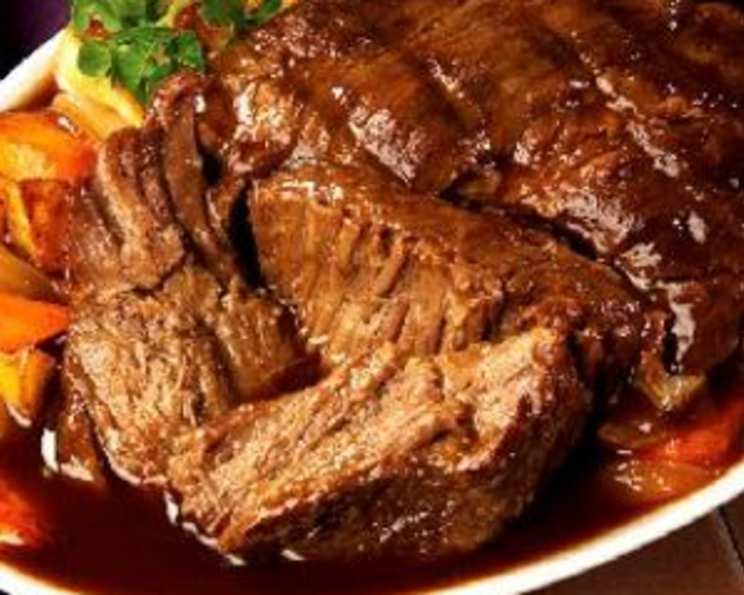
Perfect Pot Roast With Vegetables and Gravy
The aroma of pot roast simmering on a Sunday afternoon is a Proustian trigger for me, instantly transporting me back to my grandmother’s cozy kitchen. I remember the way the savory scent would permeate every corner of the house, a promise of comfort and connection. The tender, melt-in-your-mouth beef and the perfectly softened vegetables, all swimming in a rich, homemade gravy, were a testament to her love and dedication. It was a meal that nourished both body and soul, and a tradition I cherish to this day.
Recipe Overview
- Prep Time: 20 minutes
- Cook Time: 8 hours
- Total Time: 8 hours 20 minutes
- Servings: 6-8
- Yield: 1 pot roast with vegetables and gravy
- Dietary Type: Varies (see notes)
Ingredients
- 3-5 lbs blade cut chuck roast
- 2 tablespoons vegetable oil, plus more if needed
- 1 teaspoon salt, divided
- 1/2 teaspoon fresh ground black pepper, divided
- 2 medium golden onions, cut in wedges
- 2-3 carrots, cut into 2-inch sections
- 4 medium boiling potatoes, quartered
- 1 bay leaf
- 1/2 cup beef stock or 1/2 cup vegetable stock (for a lighter flavor or vegetarian option)
- 1 tablespoon unsalted butter
- 1 tablespoon flour (I prefer Wondra)
Equipment Needed
- Large skillet (not non-stick)
- Slow cooker
- Slotted spoon
- Saucepan
- Wooden spoon
- Sharp knife
Instructions
-
Season the chuck roast with 1/2 teaspoon of salt and 1/4 teaspoon of black pepper. Be generous; this is the base flavor of your dish.
-
In a large skillet (crucially, not non-stick – we need those browned bits for flavor later!), heat the vegetable oil over medium-high heat. You want the oil hot enough to sear the meat without burning.
-
Add the roast to the hot skillet and cook, turning often, until browned on all sides, about 10 minutes. Don’t rush this step! The browning process, also known as the Maillard reaction, is essential for developing a rich, deep flavor in the final dish. We are looking for a deep brown crust.
-
Transfer the browned roast to a plate and set aside.
-
If necessary, add more vegetable oil to the skillet and heat over medium-high heat.
-
Add the onions, carrots, and potatoes to the skillet and cook, stirring often, until they are slightly browned, about 5 minutes. You don’t need to fully cook the vegetables at this point; just give them some color and release their natural sweetness. Do not overcook, they should still be firm.
-
Transfer the browned vegetables to a slow-cooker. Add the bay leaf, tucking it in amongst the vegetables for even flavor distribution.
-
Place the browned roast on top of the vegetables in the slow cooker. This positioning allows the roast’s juices to drip down and flavor the vegetables as it cooks.
-
Add the beef stock (or vegetable stock) to the skillet and bring to a boil, scraping up the browned bits on the bottom of the pan with a wooden spoon. These browned bits, called fond, are packed with flavor and will add depth to your gravy.
-
Pour the stock mixture from the skillet into the slow cooker, over the roast and vegetables.
-
Cover the slow cooker and cook until the roast is fork-tender, approximately 8 hours on low (200 degrees F). The exact cooking time will depend on the size and thickness of your roast, as well as the efficiency of your slow cooker. A telltale sign of doneness is when the roast practically falls apart when gently prodded with a fork.
-
Once the roast is cooked, carefully transfer the roast and vegetables to a platter using a slotted spoon. Cover the platter with foil to keep everything warm while you prepare the gravy.
-
Skim the fat from the surface of the cooking liquid in the slow cooker. You can use a spoon or a fat separator for this step. Removing excess fat will result in a smoother, healthier gravy.
-
Remove the bay leaf from the cooking liquid and discard.
-
In a saucepan, melt the butter over very low heat. Low heat is key to preventing the butter from burning.
-
Add the flour to the melted butter and let it bubble, stirring constantly, until lightly browned, about 1 minute. This mixture, called a roux, is the foundation of your gravy. Cooking the flour slightly removes its raw taste and helps to thicken the gravy. Be careful not to burn it.
-
Whisk in the cooking liquid from the slow cooker to the roux and bring to a simmer. Whisk constantly to prevent lumps from forming.
-
Cook, whisking often, until the gravy has thickened and reduced to about 1 cup. The gravy should be thick enough to coat the back of a spoon. If the gravy is too thick, add a little more stock. If it is too thin, continue simmering until it reaches the desired consistency.
-
Using a sharp knife, slice the roast crosswise across the grain. Slicing against the grain shortens the muscle fibers, making the roast even more tender and easier to chew.
-
Serve the sliced roast with the vegetables and generously ladle the gravy over the top.
Expert Tips & Tricks
- For even more intense flavor, consider searing the roast the day before and letting it sit, covered, in the refrigerator overnight. This allows the flavors to meld and deepen.
- If you prefer your potatoes less soft, you can add them to the slow cooker about halfway through the cooking time.
- If you don’t have beef stock, you can use red wine or even strong coffee for added depth of flavor.
- To ensure your gravy is smooth and lump-free, use a whisk and gradually add the cooking liquid to the roux.
- Don’t be afraid to experiment with different herbs and spices. A sprig of rosemary or thyme added to the slow cooker can add a wonderful aroma and flavor.
Serving & Storage Suggestions
Serve your perfect pot roast immediately, garnished with fresh parsley or thyme, if desired. Leftovers can be stored in an airtight container in the refrigerator for up to 3-4 days. For longer storage, freeze the roast and vegetables separately in freezer-safe containers for up to 2-3 months. To reheat, thaw in the refrigerator overnight and then gently warm in a saucepan or microwave. Reheat the gravy separately to maintain its consistency.
Nutritional Information
| Nutrient | Amount per Serving | % Daily Value |
|---|---|---|
| Calories | 481.7 kcal | N/A |
| Calories from Fat | 183 g | 38% |
| Total Fat | 20.4 g | 31% |
| Saturated Fat | 8 g | 40% |
| Cholesterol | 154.8 mg | 51% |
| Sodium | 591.3 mg | 24% |
| Total Carbohydrate | 25.4 g | 8% |
| Dietary Fiber | 2.9 g | 11% |
| Sugars | 3.3 g | 13% |
| Protein | 50.4 g | 100% |
Note: Nutritional information is an estimate and can vary based on specific ingredients and portion sizes.
Variations & Substitutions
- Vegetarian Pot Roast: Substitute the chuck roast with a hearty mix of root vegetables like parsnips, turnips, and celeriac, along with mushrooms and lentils. Use vegetable stock instead of beef stock.
- Gluten-Free Gravy: Use a gluten-free flour blend like Bob’s Red Mill 1-to-1 Baking Flour for the roux.
- Spicy Pot Roast: Add a pinch of red pepper flakes or a chopped jalapeño to the slow cooker for a touch of heat.
- Root Vegetable Medley: Use sweet potatoes, parsnips, or turnips in addition to or in place of the potatoes and carrots.
- Wine Braised Pot Roast: Substitute half of the beef stock with a dry red wine like Cabernet Sauvignon or Merlot for a richer, more complex flavor.
FAQs (Frequently Asked Questions)
Q: Can I make this in a Dutch oven instead of a slow cooker?
A: Absolutely! Follow the same browning steps, then transfer everything to a Dutch oven, cover, and bake at 325°F (160°C) for about 3-4 hours, or until the roast is fork-tender.
Q: How do I know when the roast is done?
A: The roast is done when it’s easily pierced with a fork and practically falls apart. Internal temperature should be around 203°F (95°C).
Q: Can I use a different cut of beef?
A: While blade cut chuck roast is ideal, you can also use bottom round, rump roast, or brisket. Cooking times may vary slightly.
Q: My gravy is too thin. How do I thicken it?
A: Simmer the gravy over medium heat, whisking constantly, until it reduces to your desired consistency. Alternatively, you can mix a tablespoon of cornstarch with a tablespoon of cold water and whisk it into the gravy.
Q: Can I add other vegetables to the pot roast?
A: Of course! Celery, parsnips, and even mushrooms would be delicious additions. Just be mindful of cooking times and add vegetables that cook faster later in the process.
Final Thoughts
There’s something truly special about a perfectly executed pot roast. It’s a dish that embodies warmth, comfort, and the simple joy of sharing a delicious meal with loved ones. Don’t be intimidated by the long cooking time; the slow cooker does most of the work for you. Gather your ingredients, follow these simple steps, and prepare to be rewarded with a truly unforgettable culinary experience. I encourage you to try this recipe and make it your own, adding your personal touch and creating lasting memories around the table. And of course, I’d love to hear your feedback – share your variations and experiences in the comments below! Consider pairing it with a crusty loaf of bread for soaking up that luscious gravy, and a simple green salad to balance the richness of the dish.