
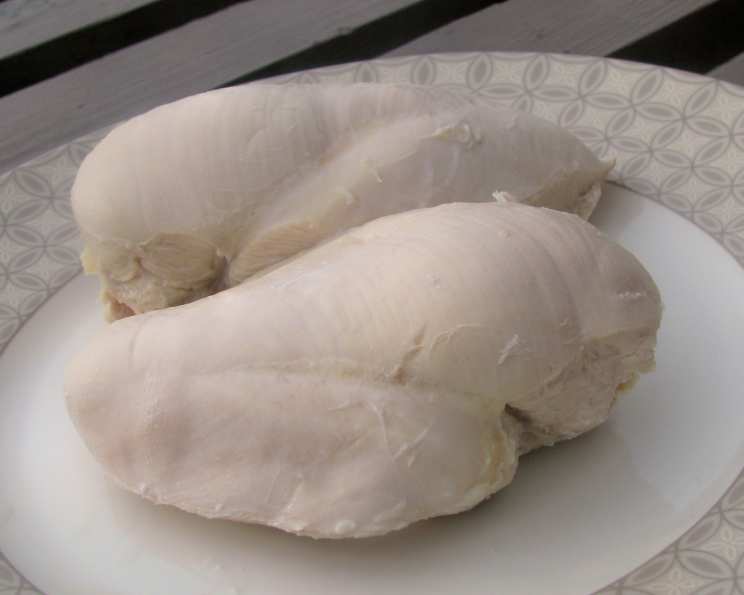
Perfectly Poached Chicken: The Secret to Exceptional Chicken Salad
I remember being a young culinary student, nervously shadowing Chef Dubois in his bustling Parisian kitchen. One sweltering summer afternoon, he tasked me with preparing the chicken for his legendary Salade de Poulet. I expected some elaborate technique, perhaps a complex marinade or a high-heat sear. Instead, he simply poached the chicken, explaining that the gentle method yielded the most tender, flavorful meat, perfect for letting the other ingredients sing. That day, I learned that sometimes, the simplest approach is truly the best.
Recipe Overview:
- Prep Time: 5 minutes
- Cook Time: 18 minutes
- Total Time: 23 minutes
- Servings: 4
- Dietary Type: Gluten-Free, Dairy-Free
Ingredients:
- 2 bone-in whole chicken breasts or 4 skinless chicken breast halves
- 2 carrots, sliced
- 1 onion, sliced
- 2 celery ribs, sliced
- Water, to cover
Equipment Needed:
- 3-quart saucepan
Instructions:
- Combine the chicken breasts, carrots, onion, and celery in a 3-quart saucepan.
- Add enough water to completely cover the ingredients.
- Bring the mixture to a boil over medium-high heat.
- Once boiling, reduce the heat to a gentle simmer. This is crucial; a rolling boil will toughen the chicken.
- As the mixture simmers, use a spoon or ladle to skim off any foam or impurities that rise to the surface. This will result in a clearer and more flavorful broth.
- If using bone-in whole chicken breasts, simmer for 15-18 minutes, or until the chicken is cooked through. If using skinless chicken breast halves, simmer for 7-10 minutes.
- To check for doneness, insert a meat thermometer into the thickest part of the chicken. It should register 165°F (74°C). Alternatively, you can pierce the chicken with a fork; if the juices run clear, it’s done.
- Crucially, allow the chicken to cool completely in the poaching liquid. This is the secret to incredibly moist and tender chicken. Letting it cool in the liquid allows the chicken to reabsorb some of the moisture, preventing it from drying out.
- Once the chicken is completely cool, remove it from the poaching liquid and drain.
- Dice the cooled chicken into bite-sized pieces.
- Use the diced chicken immediately in your favorite chicken salad recipe or pot pie filling.
- Reserve the poaching liquid. It’s now a flavorful chicken stock that can be used in soups, sauces, or risottos. Strain it through a fine-mesh sieve to remove any solids before using.
Expert Tips & Tricks:
- Don’t skip the cooling step: Cooling the chicken in the poaching liquid is paramount to achieving the most tender result. Resist the urge to rush the process.
- Herb Infusion: Add a bouquet garni (a bundle of fresh herbs like thyme, parsley, and bay leaf tied together with kitchen twine) to the poaching liquid for an extra layer of flavor. Remove the bouquet garni before cooling the chicken.
- Spice it Up: For a more exotic flavor profile, add a star anise, a cinnamon stick, or a few slices of ginger to the poaching liquid.
- Salting the Water: While the recipe doesn’t explicitly call for salt, adding a teaspoon of salt to the poaching liquid will help to season the chicken from the inside out.
- Perfectly Uniform Dice: For visually appealing chicken salad, aim for a consistent dice size when cutting the chicken.
- Skin or No Skin?: While skinless chicken breasts are perfectly acceptable, poaching bone-in, skin-on breasts results in a richer flavor and more succulent texture. Discard the skin after poaching, if desired.
- Preventing Overcooking: Overcooked chicken is dry and stringy. Use a meat thermometer to ensure the chicken reaches the correct internal temperature but doesn’t exceed it.
- Make-Ahead Marvel: Poached chicken can be made up to 3 days in advance. Store it in an airtight container in the refrigerator.
Serving & Storage Suggestions:
This poached chicken is incredibly versatile. It’s the star of chicken salad, but it can also be used in pot pies, enchiladas, tacos, or simply served cold with a vibrant vinaigrette.
Storage:
- Room Temperature: Do not leave cooked chicken at room temperature for more than 2 hours.
- Refrigerator: Store leftover poached chicken in an airtight container in the refrigerator for up to 3-4 days.
- Freezer: For longer storage, freeze the cooked chicken in an airtight container or freezer bag for up to 2-3 months. Thaw it in the refrigerator overnight before using.
Reheating:
- The best way to reheat poached chicken is gently. You can add it to a sauce or soup to warm it through, or you can microwave it in short intervals, adding a splash of water or broth to prevent it from drying out.
Nutritional Information:
(Estimated per serving, based on bone-in chicken breast)
| Nutrient | Amount per Serving | % Daily Value |
|---|---|---|
| Calories | 250 kcal | 13% |
| Total Fat | 8g | 12% |
| Saturated Fat | 2g | 10% |
| Cholesterol | 85mg | 28% |
| Sodium | 75mg | 3% |
| Total Carbohydrate | 3g | 1% |
| Dietary Fiber | 1g | 4% |
| Sugars | 1g | – |
| Protein | 35g | 70% |
Variations & Substitutions:
- Chicken Thighs: Substitute chicken thighs for the breasts for a richer, more flavorful option. Thighs will require a slightly longer poaching time.
- Vegetarian “Chicken”: For a vegetarian alternative, use firm tofu. Press the tofu to remove excess water, then cut it into cubes and poach it in the same broth for about 5-7 minutes.
- Lemon Herb: Add lemon slices and fresh herbs like rosemary and thyme to the poaching liquid for a bright, citrusy flavor.
- Spicy Kick: Add a pinch of red pepper flakes or a sliced jalapeño to the poaching liquid for a spicy kick.
- Wine Infusion: Replace half of the water with white wine for a more sophisticated flavor.
- Asian-Inspired Broth: Use ginger, garlic, soy sauce, and sesame oil to create an Asian-inspired poaching broth.
FAQs (Frequently Asked Questions):
Q: Why is it important to cool the chicken in the poaching liquid?
A: Cooling the chicken in the poaching liquid allows it to reabsorb moisture, resulting in a more tender and juicy final product. This prevents the chicken from drying out.
Q: Can I use frozen chicken breasts for this recipe?
A: Yes, you can use frozen chicken breasts, but be sure to thaw them completely before poaching. Thawing ensures even cooking and prevents the chicken from becoming rubbery.
Q: How do I know when the chicken is fully cooked?
A: The best way to check for doneness is to use a meat thermometer. Insert it into the thickest part of the chicken; it should register 165°F (74°C).
Q: Can I use this poaching method for other types of poultry?
A: Yes, this method can be adapted for other poultry like turkey or duck. Adjust the cooking time according to the size and thickness of the meat.
Q: What can I do with the leftover poaching liquid?
A: The leftover poaching liquid is a flavorful chicken stock! Strain it through a fine-mesh sieve to remove any solids and use it in soups, sauces, or risottos. You can also freeze it for later use.
Final Thoughts:
Poaching chicken is a fundamental culinary technique that yields incredibly tender and flavorful results. It’s the perfect method for preparing chicken for salads, pot pies, or any dish where you want the chicken to be moist and delicate. Don’t be intimidated by its simplicity – mastering this technique will elevate your cooking to a new level. I encourage you to try this recipe and experience the difference for yourself. Share your creations and variations with others, and let’s celebrate the art of simple, delicious cooking! Perhaps you’ll pair this poached chicken with a crisp glass of Sauvignon Blanc and a vibrant green salad for a delightful summer lunch. Enjoy!