
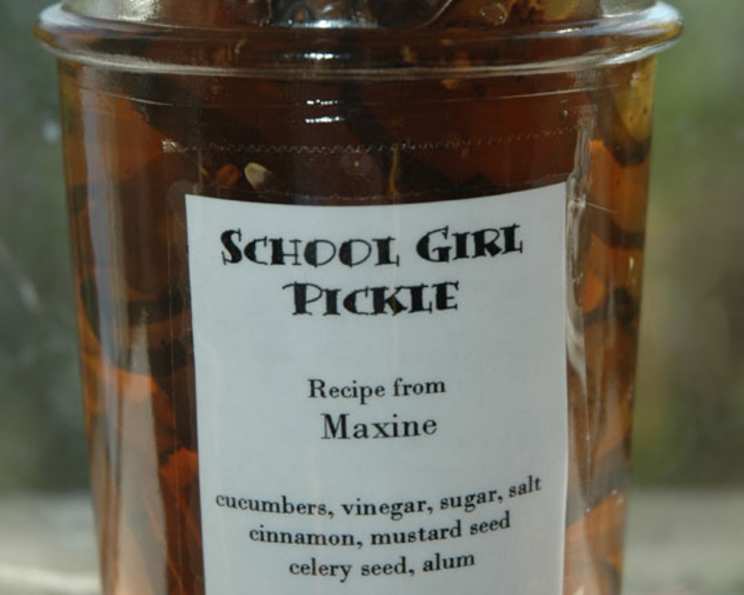
School Girl Pickle: A Sweet and Tangy Heirloom
The memory of the aroma alone transports me back to childhood summers. My great aunt Millie always had a jar of these shimmering, translucent pickles on her countertop. They were impossibly sweet, yet with a delightful tangy bite that kept you coming back for more. I can still see her, perched on her floral-patterned kitchen stool, offering me a small, crisp slice – a taste of pure sunshine bottled in glass. Her “School Girl Pickles” were legendary, a sweet-and-sour symphony that elevated every sandwich and snack.
Recipe Overview
- Prep Time: 435 hours (approx. 18 days)
- Cook Time: 0 minutes
- Total Time: 435 hours (approx. 18 days)
- Yields: 10 pints
- Serves: 100
- Dietary Type: Vegetarian (easily adaptable to vegan by ensuring vinegar is vegan-friendly)
Ingredients
- 6 lbs cucumbers
- 1 1/2 cups kosher salt
- 7 tablespoons alum
- 2 quarts vinegar (approximate)
- 2 lbs sugar (approximate)
- 4 cinnamon sticks, crushed
- 3 tablespoons mustard seeds
- 3 tablespoons celery seeds
Equipment Needed
- Large crock or food-safe container (approx. 2-gallon capacity)
- Large bowl
- Sharp knife or mandoline
- Sterile jars for canning (pint or quart)
- Plate and glass paperweight (or similar weight) to keep cucumbers submerged
Instructions
-
Begin by preparing the brine. The key here is to create a solution strong enough to float an egg. This indicates a roughly 10% brine solution – about 1 1/2 cups of kosher salt to 1 gallon of water. The water amount will vary based on the size of your crock and the volume of cucumbers, so use the floating egg test as your guide. Dissolve the salt completely in the water to form the brine.
-
Submerge the cucumbers in the brine. It’s crucial to keep them completely submerged for the entire 2-3 week soaking period. Use a plate weighted down with a glass paperweight or similar object to ensure they stay below the surface.
-
Over the next 2-3 weeks, regularly skim any scum that forms on the surface of the brine. As needed, add more salt to maintain the brine’s strength – the egg should continue to float. This step is paramount to prevent spoilage and ensure proper fermentation.
-
After the 2-3 week brining period, remove the cucumbers from the brine.
-
Using a sharp knife or mandoline, carefully cut the cucumbers into slices about 1/4 to 1/8 inch thick. Uniformity in slice thickness will ensure even pickling.
-
Place the sliced cucumbers in a large bowl and soak them in fresh water overnight. This helps to remove some of the excess salt absorbed during the brining process.
-
The next day, drain the water from the cucumbers thoroughly.
-
Prepare the alum water by dissolving 7 tablespoons of alum into enough water to cover the 6 pounds of cucumbers. Submerge the cucumber slices in the alum water and let them soak for 6 hours. Alum helps to crisp the pickles.
-
After the 6-hour soak, carefully pour off and discard the alum water.
-
Next, heat enough vinegar to cover the cucumbers to the scalding point. Do not boil; scalding means just before boiling.
-
Carefully pour the hot vinegar over the cucumbers and let them stand for 24 hours.
-
After the 24-hour soak, pour off and discard the vinegar.
-
Now it’s time to pack the pickles. In the crock or container you’re using, alternate layers of cucumber slices, sugar, and spices (crushed cinnamon sticks, mustard seeds, and celery seeds), until all ingredients are used. Start with a layer of cucumbers, then sprinkle with some of the sugar and spices, and repeat. The approximate amounts of vinegar and sugar are just that. Add sugar to your liking, depending on how sweet you want your pickles.
-
Let the mixture stand for 3 days. During this time, the sugar will dissolve and create a syrup-like brine.
-
The pickles are now ready for use. You can pack them into sterile jars for longer storage.
-
To store, pack the pickles into sterile jars. I often put some in our pantry for immediate use and give the rest away as gifts.
-
Although these pickles are naturally preserved through brining, vinegar, and high sugar content, you can process them in a boiling water bath for 10 minutes if you prefer extra assurance of long-term storage safety.
Expert Tips & Tricks
- The floating egg test is the most reliable way to gauge the brine’s salinity. Use a fresh, uncracked egg.
- Don’t be afraid to adjust the sugar level to your preference. Some people prefer a tangier pickle, while others like them very sweet.
- Crushing the cinnamon sticks releases more of their flavor.
- If you don’t have a crock, a large food-grade plastic bucket will work.
- Ensure your pickling spices are fresh for the best flavor.
Serving & Storage Suggestions
These pickles are fantastic as a side with sandwiches, burgers, or grilled meats. They also make a delicious addition to charcuterie boards. To store, keep the pickles in their brine in sterilized jars in a cool, dark place. Properly sealed and stored, they should last for several months, even up to a year. I have never had them long enough to find out for sure!
Nutritional Information
Please note: Nutritional information is estimated and may vary based on specific ingredients and portion sizes.
| Nutrient | Amount per Serving | % Daily Value |
|---|---|---|
| Calories | 44.4 kcal | N/A |
| Calories from Fat | 1 g | 3% |
| Total Fat | 0.1 g | 0% |
| Saturated Fat | 0 g | 0% |
| Cholesterol | 0 mg | 0% |
| Sodium | 1699 mg | 70% |
| Total Carbohydrate | 10.2 g | 3% |
| Dietary Fiber | 0.2 g | 0% |
| Sugars | 9.5 g | 38% |
| Protein | 0.3 g | 0% |
Variations & Substitutions
- Spicy School Girl Pickles: Add a pinch of red pepper flakes or a sliced jalapeño to the spice mixture for a touch of heat.
- Herbed School Girl Pickles: Incorporate fresh dill, thyme, or rosemary for a more complex flavor profile.
- Sugar Alternatives: Experiment with honey or maple syrup in place of granulated sugar, adjusting the quantity to taste.
FAQs (Frequently Asked Questions)
Q: Why does this recipe take so long?
A: The extended brining process is essential for drawing out moisture from the cucumbers and infusing them with flavor, resulting in a crisp and shelf-stable pickle.
Q: Can I use regular table salt instead of kosher salt?
A: Kosher salt is preferred because it doesn’t contain iodine or anti-caking agents, which can affect the flavor and color of the pickles. If you must use table salt, reduce the amount slightly.
Q: Do I have to use alum?
A: Alum is optional, but it helps to keep the pickles firm and crisp. If you prefer to avoid it, you can skip it, but the pickles may be slightly softer.
Q: Is it safe to skip the processing step?
A: Since these pickles are high in sugar and vinegar, they are naturally preserved. However, processing them in a boiling water bath provides an extra layer of safety for long-term storage.
Q: Can I use different types of cucumbers?
A: Kirby cucumbers are ideal for pickling because of their firm texture and small size. However, you can use other varieties, such as English cucumbers, but be sure to remove the seeds first.
Final Thoughts
These School Girl Pickles are more than just a recipe; they’re a piece of history and a taste of nostalgia. Don’t be intimidated by the long preparation time; the hands-on work is minimal, and the results are well worth the effort. Share them with friends and family, and watch their faces light up with that same sweet and tangy delight that I remember from my childhood. Perhaps you’ll even create a new family tradition of your own. Enjoy!