
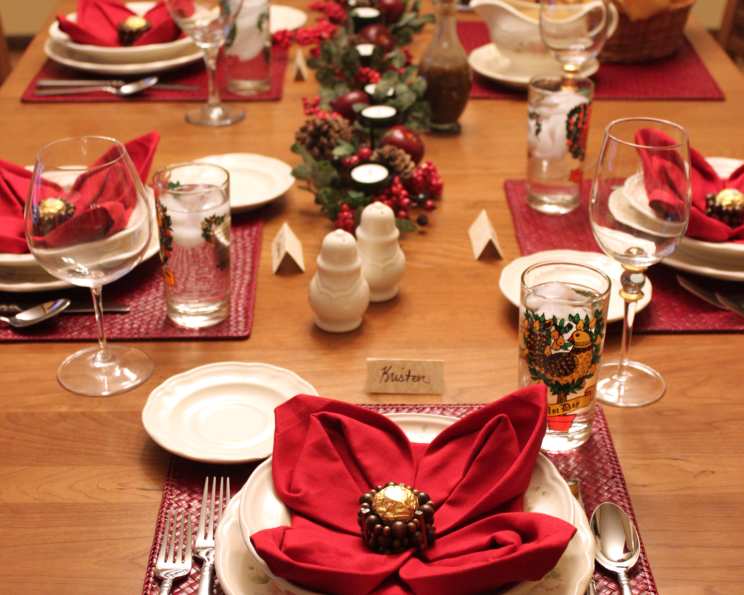
Serviette/Napkin Folding: Marie’s Lily Pad Flower
My earliest memories of beautifully set tables aren’t filled with fancy china, but rather the intricate folds of the napkins that adorned each place setting. My grandmother, a woman of impeccable taste and endless patience, would spend hours teaching my sisters and me the art of turning simple squares of fabric into swans, fans, and elaborate flowers. It wasn’t just about making the table look pretty; it was about adding a touch of elegance and care to every meal, a subtle reminder that even the simplest moments deserved to be celebrated. The Lily Pad Flower, while not one of her original repertoire, brings back that same feeling of quiet artistry and mindful preparation.
Recipe Overview:
- Prep Time: 3 minutes
- Total Time: 3 minutes
- Servings: 1
- Yield: 1 Flower
- Dietary Type: N/A (decorative)
Ingredients:
- 1 large paper serviette/napkin
- OR 1 large cloth serviette/napkin
Equipment Needed:
- Iron (optional, for cloth napkins)
Instructions:
-
Begin by laying your serviette flat on a clean, even surface. If using a cloth napkin, for best results ensure it is ironed smooth. Orient the serviette so it forms a square in front of you.
-
Take the top right corner of the square serviette and fold it inward, bringing the point to meet the precise center point of the entire square. Press down lightly to crease the fold.
-
Repeat the previous step with the remaining three corners. Fold the top left corner, bottom left corner, and bottom right corner into the center point of the original square. Once all four corners are folded in, the serviette will now resemble a diamond shape.
-
Now, take the East point (the rightmost point) of the diamond and fold it inward towards the center point of the diamond. Crease gently.
-
Repeat this folding process with the other three points of the diamond. Fold the North point, South point, and West point into the center point. After this step, the serviette should once again resemble a square. You will notice what appear to be small gaps in an X formation underneath the folded flaps.
-
Carefully flip the entire serviette over, maintaining its square shape. The underside should now be facing up.
-
Similar to step 3, fold each of the four corners of this side into the center point. This means bringing the top right corner, top left corner, bottom left corner, and bottom right corner to meet in the middle.
-
Carefully turn the serviette back over to the previous side (the side with the smaller folded squares) You will now see four loose points on the underside of the folded corners. Note: This step is only to make the next step clearer in demonstrating where to find the loose points.
-
Turn the serviette back over to the previous side, the side with the smaller folded squares, lay the serviette down on the surface, and press firmly on the center point where all four corners meet. This will help to stabilize the structure.
-
Carefully reach underneath the serviette with your other hand and grab one of the loose points located on the underside of the folded corners. Gently pull this loose point outwards, bringing it to the outside of the corner to which it belongs. This action creates the outer petal of that quarter of the flower.
-
Repeat the previous step with the other three corners, pulling each of the remaining three loose points outwards to form the remaining “petals” of the lily pad flower.
-
If you are not planning to place an object (such as a glass or candle) in the center of the lily pad flower, you may need to carefully secure the four central points with a pin to prevent them from unfolding. This is particularly helpful when using paper napkins.
Expert Tips & Tricks:
- Ironing is Key: For cloth napkins, ironing is crucial for achieving crisp, clean folds. Starch can also be used to make the folds even more defined.
- Paper Napkin Selection: If using paper napkins, opt for high-quality, multi-ply napkins. Thinner napkins tend to tear easily during the folding process.
- Practice Makes Perfect: Don’t be discouraged if your first attempt isn’t perfect. Like origami, napkin folding takes practice.
- Secure with Style: If you need to secure the central points, consider using decorative pins or small adhesive gems for an added touch of elegance.
- Vary the Size: Experiment with different sized napkins to create different sized Lily Pad Flowers. Smaller napkins can be used for individual place settings, while larger napkins can be used as decorative centerpieces.
- Fabric Matters: Different fabrics will yield different results. Linen and cotton hold their shape well, while silk and satin will create a softer, more flowing look.
Serving & Storage Suggestions:
The Marie’s Lily Pad Flower is best used immediately after folding. It serves as a decorative element on a table setting and can be used as a base for glasses, small dishes, or decorative items.
Storage is generally not applicable, as the folded napkin is intended for immediate use. However, if you wish to preserve the fold, you can lightly spray it with hairspray to help it hold its shape. Store in a cool, dry place away from direct sunlight to prevent fading.
Nutritional Information:
As this recipe involves folding napkins, there is no nutritional information to provide.
Variations & Substitutions:
- Color Coordination: Choose napkins in colors that complement your table setting or the theme of your event.
- Pattern Play: Use patterned napkins for a more visually interesting flower. Just be mindful that intricate patterns may make the folds less distinct.
- Layered Look: Use two different colored napkins, layering one on top of the other before folding. This will create a two-toned effect in the finished flower.
- Adding Embellishments: Once the flower is folded, add small embellishments such as ribbons, beads, or dried flowers to the center for a personalized touch.
FAQs (Frequently Asked Questions):
Q: What kind of napkins work best for this fold?
A: Large, square napkins are ideal. Both cloth and high-quality paper napkins can be used, but ironed cloth napkins generally create a more polished look.
Q: Is it difficult to fold this Lily Pad Flower?
A: While it may seem complex at first, with practice and patience, this fold becomes quite easy. The step-by-step instructions and visual aids make it accessible to beginners.
Q: Can I use smaller napkins for this fold?
A: Yes, you can use smaller napkins, but the finished flower will be smaller as well. Adjust the size of the center object accordingly.
Q: How can I prevent the flower from unfolding?
A: Pressing firmly on the center point during the folding process and securing the central points with a pin or adhesive can help prevent the flower from unfolding.
Q: What is the origin of the name “Marie’s Lily Pad Flower”?
A: This particular fold was taught to me by a friend named Marie, who originally did origami. The visual similarity to a lily pad flower inspired the name.
Final Thoughts:
I hope you’ll embrace the charm and simplicity of Marie’s Lily Pad Flower and add a touch of handmade elegance to your next gathering. It’s more than just a napkin fold; it’s an opportunity to create a memorable experience for your guests. Don’t hesitate to experiment with different colors, patterns, and embellishments to make it uniquely your own. Share your creations, seek feedback, and most importantly, enjoy the process! And if you are struggling at any point, you can always add a small tea-light candle into the center, it will hide any small imperfections.