
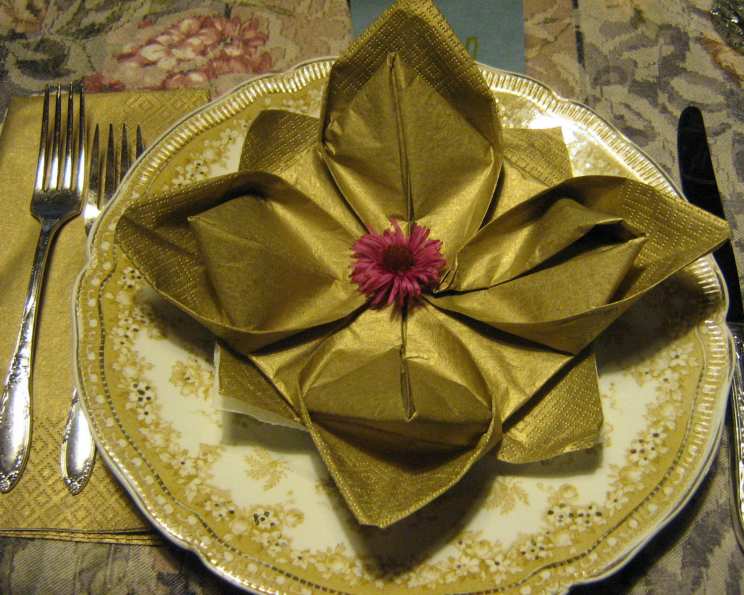
The Art of the Fold: Crafting a Lotus Napkin
My grandmother, a woman of quiet elegance, always believed that even the simplest meal could be elevated with a touch of grace. I remember being captivated as a child, perched on a stool in her sun-drenched dining room, watching her transform ordinary napkins into swans, fans, and intricate flowers. Each fold was deliberate, a testament to her belief in the power of small details. The Lotus, with its layered petals and serene beauty, evokes those afternoons filled with her gentle guidance and the comforting rhythm of the iron on linen. It’s more than just a napkin fold; it’s a symbol of the care and attention we bring to our tables, transforming a simple setting into something truly special.
Recipe Overview
- Prep Time: 2 minutes
- Serves: 2
- Dietary Type: N/A (Serviette folding is not edible.)
Ingredients
- 1 large paper serviette
- 1 large cloth serviette
Equipment Needed
None. Just a flat surface is required.
Instructions
- Begin by laying your serviette flat before you on your work surface, ensuring it is in a square shape.
- Take the top right corner and fold the point into the center point of the square.
- Repeat this action with the remaining three corners, folding each point into the center. You should now have a diamond shape in front of you.
- Next, take the East point of the diamond and fold it into the center point.
- Repeat with the other three corners, folding each point into the center. The serviette should now be square again, and it will have gaps in the form of an “X”.
- Carefully turn the serviette over to the other side.
- Fold each of the four corners into the center point once again.
- Carefully turn the serviette over to the previous side. You will now see four loose points on the underside. (This step is only to make the next step clearer.)
- Turn back over to the previous side.
- Lay the serviette down and press firmly on the center point where the four corners meet.
- Carefully reach underneath with your other hand and grab one of the loose points on the underside.
- Bring that loose point to the outside of the corner that it belongs to. This action creates the outer petal of that quarter of the flower.
- Repeat this process with the other three corners, pulling each of the loose points to the outside.
- At this stage, you have created what I call “Marie’s Lily Pad Flower”.
- To transform it into the Lotus, which calls for an extra step, reach underneath again.
- You will discover a second layer of four flaps on the bottom.
- Gently pull these flaps out to the front side, while firmly holding the center points to ensure everything stays intact.
- You will now have a fuller-looking flower that has additional petals/leaves at the sides, in between the main petals. This final addition transforms the napkin into a “Lotus”.
Expert Tips & Tricks
- Starch is your friend: For a crisper, more defined Lotus, lightly starch your cloth napkins before ironing and folding. This will give the folds more structure and hold.
- Ironing is essential: Iron your napkins after each major folding step. This creates sharp, clean lines and ensures the Lotus looks elegant.
- Practice makes perfect: Don’t be discouraged if your first attempt isn’t perfect. Like any skill, napkin folding improves with practice.
- Use contrasting colors: For a visually stunning effect, try using two napkins of different colors, layering them before you begin folding. The contrasting colors will highlight the different petals of the Lotus.
- Experiment with fabric: Different fabrics will yield different results. Linen and cotton are traditional choices, but you can also experiment with silk or satin for a more luxurious look.
- Size matters: Larger napkins (at least 20×20 inches) are easier to work with, especially when learning the Lotus fold. Smaller napkins may not have enough fabric to create the desired effect.
- Secure the center: When pulling out the final layer of petals, hold the center of the napkin firmly to prevent the entire structure from collapsing.
Serving & Storage Suggestions
The Lotus napkin fold is best used to elevate the presentation of your dining table for special occasions, such as dinner parties, weddings, or holiday gatherings. It is not edible and should be disposed of or stored for future use.
- Presentation: Place the folded Lotus napkin in the center of each dinner plate for a striking visual statement. Alternatively, you can position it to the side of the plate, creating a more subtle yet elegant touch.
- Storage: Unfold the Lotus napkin after use and store it flat in a drawer or linen closet. If the napkin is stained, wash it according to the fabric’s care instructions before storing it. For cloth napkins, ironing after washing will help maintain their crispness.
- Reusing: The beauty of napkin folding is that you can use the same napkin many times, if handled carefully.
Nutritional Information
As this is a non-edible craft, nutritional information is not applicable.
| Nutrient | Amount per Serving | % Daily Value |
|---|---|---|
| Calories | 0 kcal | 0% |
| Total Fat | 0g | 0% |
| Saturated Fat | 0g | 0% |
| Cholesterol | 0mg | 0% |
| Sodium | 0mg | 0% |
| Total Carbohydrate | 0g | 0% |
| Dietary Fiber | 0g | 0% |
| Sugars | 0g | 0% |
| Protein | 0g | 0% |
Variations & Substitutions
While the basic Lotus fold remains the same, you can experiment with different materials and embellishments to create unique variations:
- Color Variations: Use napkins in different colors or patterns to match your table setting or the theme of your event.
- Fabric Variations: Try folding the Lotus with silk or satin napkins for a more luxurious and elegant look.
- Embellishments: Add small embellishments to the center of the Lotus, such as a pearl, a small flower, or a ribbon, to personalize the design.
- Double Lotus: Create a more elaborate version by folding two Lotus napkins together, one slightly smaller than the other, to create a layered effect.
- Themed Lotus: Adapt the Lotus fold to match specific themes, such as using green napkins for a St. Patrick’s Day celebration or red and white napkins for a Christmas dinner.
FAQs (Frequently Asked Questions)
Q: What size napkin works best for the Lotus fold?
A: A large napkin, at least 20×20 inches, is ideal for creating the Lotus fold. Smaller napkins may not have enough fabric to achieve the desired effect.
Q: Can I use paper napkins for the Lotus fold?
A: Yes, you can use paper napkins, but cloth napkins generally hold their shape better and create a more elegant presentation.
Q: How do I keep the Lotus fold from unraveling?
A: Ironing the napkin after each major folding step will help to keep the folds crisp and prevent them from unraveling.
Q: Is it possible to fold the Lotus in advance?
A: Yes, you can fold the Lotus napkins in advance and store them flat until you are ready to use them. However, be sure to protect them from dust and moisture.
Q: How do I clean cloth napkins that have been folded into the Lotus?
A: Unfold the napkins and wash them according to the fabric’s care instructions. Ironing after washing will help to maintain their crispness.
Final Thoughts
The Lotus napkin fold, with its simple yet elegant design, is a beautiful way to add a touch of sophistication to any dining experience. It’s a craft that’s passed down through generations, imbued with the love and care of home. So, gather your napkins, unleash your inner artist, and transform your table into a work of art. Don’t be afraid to experiment with different colors, fabrics, and embellishments to create your own unique variations. And most importantly, enjoy the process of creating something beautiful for yourself and your loved ones. Share your creations with friends and family, and let the beauty of the Lotus inspire moments of connection and joy around your table.