
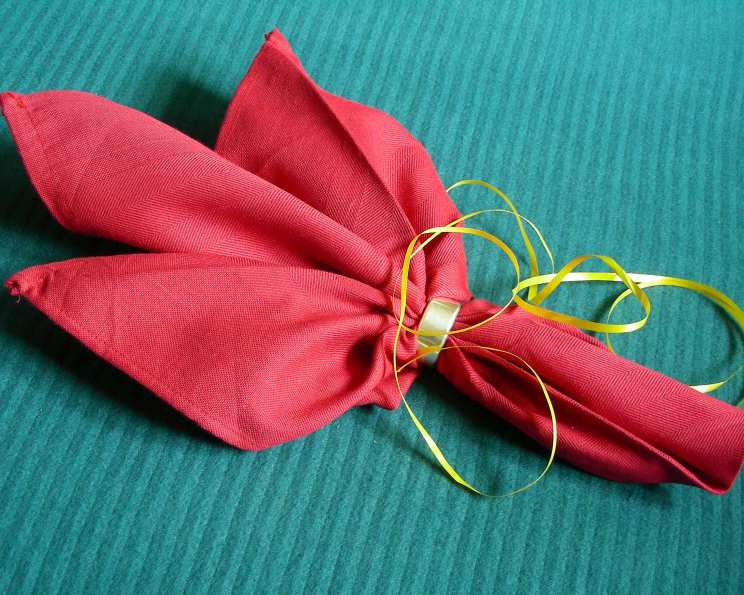
The Elegance of Simplicity: Mastering the Tulip Napkin Fold
My grandmother, a woman whose hands were perpetually busy, whether tending her rose garden or whipping up a batch of her legendary shortbread cookies, always believed that even the simplest meal deserved a touch of elegance. I recall countless Sunday dinners where, alongside her hearty roast and creamy mashed potatoes, sat meticulously folded napkins. It wasn’t just about wiping your hands; it was about elevating the experience. One of my favourite folds was the tulip; it transforms a humble square of cloth into a statement of grace, a small but significant gesture of care and attention. Today, I’m delighted to share this classic technique with you.
Recipe Overview
- Prep Time: 5 minutes
- Total Time: 5 minutes
- Servings: Varies based on event size
- Yield: 1 folded napkin
- Dietary Type: Not Applicable
Ingredients
- 1 large paper serviette OR 1 large cloth serviette
- 1 napkin ring
Equipment Needed
- Flat surface
Instructions
- Begin by laying your chosen serviette flat on a surface. If you are using a paper one, ensure it is sturdy. If using cloth, it helps to have it lightly starched and ironed. Position the serviette so it resembles a diamond, with one point facing you and the opposite point furthest away.
- Take the bottom point (the South point) of the diamond and fold it upwards, aligning it precisely with the top point (the North point) of the diamond. This will create a triangle.
- Now, place one hand firmly on the North point of the triangle. Use your other hand to locate the center of the base of the triangle. Gently lift the serviette upwards, creating a ridged pleat that stands upright between your fingers. The goal is to form a distinct vertical crease running down the center of the triangle.
- Carefully lay the serviette down flat once more. You should now have a triangle with a clearly defined, raised ridge running vertically through its center. This is the foundation of your tulip.
- Next, take the right point (the East point) of the triangle and bring it up towards the North point. Fold the East point so that it reaches approximately halfway between its original position and the North point. This will create a pleat on the right-hand side of the serviette.
- Repeat this process with the left point (the West point). Bring the West point up to meet a point halfway towards the North point, mirroring the fold you made on the right side. This creates a balanced pleat on the left side.
- Carefully slide the napkin ring onto the base of the serviette, encompassing the area where the folds meet. Position the ring about one-third of the way up from the base. The ring should snugly hold the folded shape in place.
- Finally, gently fan out the tulip. Adjust the pleats, ensuring the central pleat and the side pleats are symmetrical and pleasing to the eye. The central pleat should ideally be slightly longer than the two side pleats, creating the distinct “tulip petal” effect.
Expert Tips & Tricks
- Fabric Choice Matters: While you can achieve this fold with paper napkins, cloth napkins, especially those with a bit of weight and body, will hold their shape much better and look more elegant. Linen or a cotton-linen blend are excellent choices.
- Ironing is Your Friend: For cloth napkins, a light starch and a good ironing before you begin will make the folding process much easier and result in a crisper, more defined final product.
- Practice Makes Perfect: Don’t be discouraged if your first attempt isn’t perfect. Like any skill, napkin folding improves with practice.
- Vary the Height: Experiment with the height at which you place the napkin ring to achieve different looks. A higher placement will create a more closed, bud-like tulip, while a lower placement will result in a more open, blooming tulip.
- Secure the Base: Make sure the base is secure within the napkin ring. Adjusting the fan after the ring is on ensures that the folds stay neat.
Serving & Storage Suggestions
The tulip napkin fold is best displayed on individual place settings, either on the plate itself or to the left of the silverware.
- If you are preparing the napkins ahead of time, store them upright in a container or tray to prevent them from losing their shape. Cover loosely with plastic wrap if necessary.
- Cloth napkins can be unfolded and washed as usual after use. Paper napkins are typically discarded.
Nutritional Information
As this recipe involves only folding, and no consumption of ingredients, there is no nutritional information to provide.
| Nutrient | Amount per Serving | % Daily Value |
|---|---|---|
| Calories | 0 kcal | 0% |
| Total Fat | 0g | 0% |
| Saturated Fat | 0g | 0% |
| Cholesterol | 0mg | 0% |
| Sodium | 0mg | 0% |
| Total Carbohydrate | 0g | 0% |
| Dietary Fiber | 0g | 0% |
| Sugars | 0g | 0% |
| Protein | 0g | 0% |
Variations & Substitutions
- Double Napkin: Use two napkins, one a solid color and the other patterned, for a layered effect. Place the patterned napkin on top of the solid one before folding.
- Ribbon Accent: Instead of a napkin ring, tie a delicate ribbon around the base of the folded napkin.
- Seasonal Touches: Add a small sprig of fresh herbs, a flower, or a decorative charm to the center of the tulip for a seasonal touch.
- Monogramming: If you have cloth napkins, consider having them monogrammed for a personal touch.
FAQs (Frequently Asked Questions)
Q: Can I use paper napkins for this fold?
A: Yes, you can, but the results will be much better with cloth napkins. Paper napkins tend to be less sturdy and may not hold their shape as well.
Q: What size napkin is best for this fold?
A: A large napkin, typically around 20×20 inches for cloth or a similar size for paper, is ideal. Smaller napkins may not create a full, impressive tulip.
Q: How can I keep the napkins from unfolding before the meal?
A: Ensure the napkin ring fits snugly and the base of the tulip is securely tucked inside it. Starching the napkins also helps them maintain their shape.
Q: Is it difficult to learn this fold?
A: Not at all! With a little practice, the tulip fold is quite simple to master. The key is to follow the instructions carefully and take your time.
Q: Can I use different types of napkin rings?
A: Absolutely! Experiment with different materials and styles of napkin rings to complement your table setting. Metal, wood, and even beaded rings can all work well.
Final Thoughts
The tulip napkin fold is more than just a decorative touch; it’s an expression of care and attention to detail that can elevate any meal, from a casual weeknight dinner to a formal holiday feast. I encourage you to give it a try and discover the joy of transforming a simple square of fabric into a beautiful work of art. Share your creations with loved ones and let them experience the elegance of a perfectly folded tulip.