
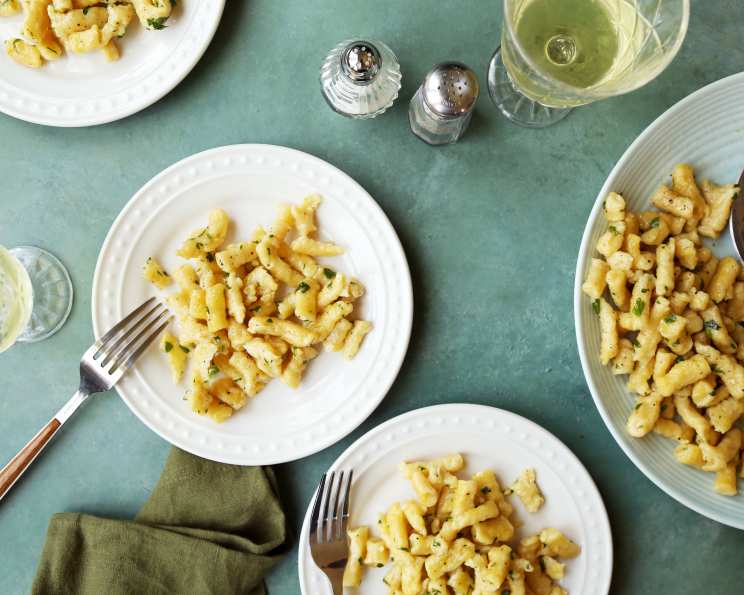
Spaetzle: A Taste of Home
The scent of simmering dough and melted butter always takes me back to my grandmother’s kitchen in Germany. As a child, I’d perch on a stool, mesmerized as she transformed a simple mixture of flour, eggs, and water into delicate, irregularly shaped noodles – spaetzle. Each batch was a labor of love, and every bite a warm embrace. Now, years later, I recreate that magic, sharing this beloved dish with my own family, a taste of heritage passed down through generations.
Recipe Overview
- Prep Time: 15 minutes
- Cook Time: 15 minutes
- Total Time: 30 minutes
- Servings: 4-6
- Yield: About 4 cups
- Dietary Type: Vegetarian
Ingredients
- 3 cups unbleached flour
- 4 large eggs, beaten
- 1 teaspoon salt
- ½ cup water (or more, as needed)
- ¼ teaspoon nutmeg
- ¼ cup butter
Equipment Needed
- Large mixing bowl
- Wooden spoon
- Large pot
- Spaetzle maker or colander with medium-sized holes
- Slotted spoon
- Paper towels
- Large skillet
Instructions
- In a large mixing bowl, sift together the flour, salt, and nutmeg. This ensures even distribution of the ingredients and prevents lumps in the dough.
- Create a well in the center of the dry ingredients. Pour the beaten eggs and ¼ cup of water into the well.
- Using a sturdy wooden spoon, begin to beat the wet ingredients into the dry ingredients. Start slowly, gradually incorporating the flour from the edges of the well.
- Continue to mix until a dough begins to form. The dough should be slightly sticky, but still elastic and stiff. This is crucial for achieving the correct texture of the spaetzle.
- Gradually add more water, a tablespoon at a time, until the dough reaches the desired consistency. It should be thick enough to hold its shape but thin enough to be pushed through a spaetzle maker or colander. Don’t overmix.
- Bring a large pot of salted water to a rolling boil. The salt is essential for seasoning the spaetzle from the inside out.
- If using a spaetzle maker, place it over the boiling water and fill the hopper with the dough. Press the dough through the holes, allowing the spaetzle to drop directly into the boiling water. If using a colander, hold it over the pot and use a spatula or spoon to press the dough through the holes. Work in batches to avoid overcrowding the pot.
- Cook the spaetzle in the boiling water for about 5 minutes, or until they rise to the surface. This indicates that they are cooked through.
- Using a slotted spoon, remove the cooked spaetzle from the water and drain them on paper towels. This step is important to remove excess water and prevent the spaetzle from becoming soggy.
- In a large skillet, melt the butter over low heat.
- Add the drained spaetzle to the melted butter and brown them gently, stirring occasionally, until they are lightly golden and slightly crispy. Be careful not to burn the butter or the spaetzle.
- Serve immediately.
Expert Tips & Tricks
- Dough Consistency is Key: The spaetzle dough should be thick but still pliable. The consistency can vary slightly depending on the humidity and the type of flour used. Adjust the amount of water accordingly. If the dough is too thick, the spaetzle will be dense and heavy. If it’s too thin, they will fall apart in the boiling water.
- Don’t Overcrowd the Pot: Cook the spaetzle in batches to prevent them from sticking together. Overcrowding the pot will also lower the water temperature, which can result in unevenly cooked spaetzle.
- Spaetzle Makers: While a spaetzle maker simplifies the process, a colander with medium-sized holes works well. You can also use a flat grater or even a cutting board and knife to make spaetzle by hand (though this requires more skill and patience).
- Flavor Enhancements: Consider adding finely chopped herbs (parsley, chives) to the dough for extra flavor. A pinch of garlic powder or onion powder can also add a savory note.
- Make-Ahead Tip: The spaetzle dough can be made ahead of time and stored in the refrigerator for up to 24 hours. Allow it to come to room temperature before cooking. Cooked spaetzle can also be stored in the refrigerator for up to 3 days. Reheat them in a skillet with butter or oil until heated through.
Serving & Storage Suggestions
Spaetzle is incredibly versatile. Serve it as a side dish with roasted meats, sausages, or stews. It’s also delicious as a main course, tossed with melted cheese, browned butter, or a creamy sauce. For a simple and satisfying meal, top it with sauteed onions and mushrooms.
Leftover spaetzle can be stored in an airtight container in the refrigerator for up to 3 days. To reheat, sauté in a skillet with a little butter or oil until warmed through and slightly crispy. You can also freeze cooked spaetzle for longer storage. Spread them out on a baking sheet to freeze individually, then transfer to a freezer bag. They can be reheated directly from frozen.
Nutritional Information
| Nutrient | Amount per Serving | % Daily Value |
|---|---|---|
| Calories | 515 kcal | N/A |
| Total Fat | 17g | 26% |
| Saturated Fat | 9g | 45% |
| Cholesterol | 217mg | 72% |
| Sodium | 757mg | 31% |
| Total Carbohydrate | 72g | 23% |
| Dietary Fiber | 3g | 10% |
| Sugars | 1g | N/A |
| Protein | 16g | 32% |
Note: Nutritional information is an estimate and may vary based on specific ingredients and preparation methods.
Variations & Substitutions
- Cheese Spaetzle (Käsespätzle): Add grated cheese (such as Gruyere, Emmental, or cheddar) to the spaetzle while browning in butter.
- Herb Spaetzle: Mix finely chopped fresh herbs (parsley, chives, thyme) into the dough.
- Spinach Spaetzle: Add pureed spinach to the dough for a vibrant green color and extra nutrients.
- Gluten-Free Spaetzle: Use a gluten-free flour blend in place of the unbleached flour. You may need to adjust the amount of water to achieve the correct dough consistency.
- Vegan Spaetzle: Substitute the eggs with a flax egg (1 tablespoon flaxseed meal mixed with 3 tablespoons water) and use plant-based butter.
FAQs (Frequently Asked Questions)
Q: Why is my spaetzle dough too sticky?
A: It could be that you’ve added too much water. Try adding a little more flour, a tablespoon at a time, until the dough reaches the desired consistency.
Q: How do I prevent my spaetzle from sticking together in the pot?
A: Make sure to cook the spaetzle in batches to avoid overcrowding the pot. Adding a tablespoon of oil to the boiling water can also help prevent sticking.
Q: Can I use a food processor to make the spaetzle dough?
A: While you can use a food processor, it’s easy to overmix the dough, which can result in tough spaetzle. Mixing by hand with a wooden spoon is generally recommended.
Q: What kind of cheese is best for Käsespätzle?
A: Gruyere, Emmental, and cheddar are all excellent choices. You can also use a combination of different cheeses to create a more complex flavor.
Q: Can I freeze uncooked spaetzle dough?
A: It’s best to cook the spaetzle before freezing. Uncooked dough can become gummy and lose its texture when frozen.
Final Thoughts
I hope this recipe inspires you to create your own batch of spaetzle and experience the simple joy of homemade noodles. Don’t be intimidated by the process – with a little practice, you’ll be able to whip up a batch in no time. And if you do try it out, I’d love to hear about your experience. Share your creations and feedback, and perhaps pair your spaetzle with a crisp German beer or a hearty beef stew for a truly authentic experience. Guten Appetit!