
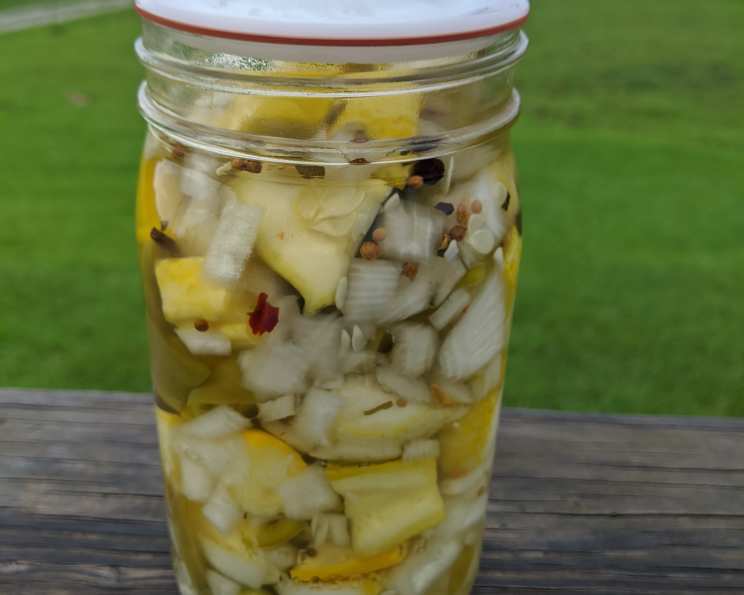
Squash Pickles: A Sweet and Tangy Summer Delight
I remember the first time I tasted squash pickles. It was at a county fair, and my grandmother, a woman whose garden was legendary, proudly presented a jar of these golden, glistening delights. I was hesitant, pickles weren’t usually my thing, but one bite and I was hooked. The perfect balance of sweet and tangy, the satisfying crunch – they were unlike anything I’d ever tasted. That day, a simple squash pickle transformed from a mere condiment to a cherished memory, a taste of summer bottled up for the colder months.
Recipe Overview
- Prep Time: 2 hours
- Cook Time: 45 minutes
- Total Time: 2 hours 45 minutes
- Yields: 4 quarts
- Dietary Type: Vegetarian, Gluten-Free
Ingredients
- 13 cups squash, cubed or sliced (or ½ squash and ½ cucumber, cubed or sliced)
- 6 bell peppers, sliced
- 3 cups sliced onions
- 3 ½ cups vinegar
- 2 ½ cups sugar
- 4 teaspoons pickling spices
- ½ cup salt
Equipment Needed
- Large bowl
- Large pot or Dutch oven
- Sterilized canning jars (4 quart-sized) with lids and rings
- Canning tools: jar lifter, funnel
- Candy thermometer
- Large spoon or ladle
- Water bath canner
Instructions
-
Begin by thoroughly slicing or cubing the squash (and cucumber, if using), bell peppers, and onions. Uniform size helps ensure even pickling.
-
In a large bowl, combine the sliced vegetables and salt. Mix well to ensure the salt is evenly distributed. The salt draws out excess moisture from the vegetables, which contributes to a crispier pickle.
-
Allow the salted vegetable mixture to set for 1 hour. This step is crucial for removing excess water and achieving the desired pickle texture.
-
After the hour has passed, thoroughly drain the vegetable mixture to remove the accumulated liquid. You can gently press the vegetables to extract more liquid, but avoid crushing them.
-
In a large pot or Dutch oven, combine the vinegar and sugar. Bring to a boil over medium-high heat, stirring occasionally to ensure the sugar dissolves completely.
-
Once the vinegar and sugar mixture is boiling, carefully add the drained squash mixture to the pot.
-
Bring the mixture back to a boil, stirring gently to prevent sticking and ensure the vegetables are evenly coated with the vinegar mixture.
-
While the squash mixture is heating, prepare your sterilized canning jars. Place 1 teaspoon of pickling spice into each heated jar. The pickling spice adds a complex layer of flavor to the pickles.
-
Using a jar lifter, carefully remove the heated jars from the simmering water (or sterilizer) and place them on a clean towel-lined surface.
-
Once the squash mixture has returned to a boil, carefully pack the hot squash mixture into the prepared jars, leaving ½ inch of headspace at the top. Tightly pack the squash to maximize the amount in each jar.
-
Use a clean, damp cloth to wipe the rims of the jars to remove any food residue. This ensures a proper seal.
-
Place the lids on the jars and screw on the rings until they are fingertip tight. Avoid over-tightening, as this can prevent the jars from sealing properly.
-
Using the jar lifter, carefully lower the filled jars into a water bath canner. Ensure the jars are completely covered with water; add more boiling water if necessary.
-
Bring the water to a gentle boil and process the jars for 30 minutes, maintaining a water temperature between 180-185°F (low temperature pasteurization). This low temperature helps to preserve the texture of the squash. Use a candy thermometer to carefully monitor the water temperature.
-
After 30 minutes, carefully remove the jars from the water bath canner using the jar lifter and place them on a clean towel-lined surface to cool.
-
As the jars cool, you should hear a popping sound, which indicates that the jars have sealed properly.
-
Allow the jars to cool completely (about 12-24 hours) before checking the seals. To check the seal, press down on the center of the lid. If it doesn’t flex, the jar is sealed. If the lid flexes, the jar is not sealed and should be refrigerated and used promptly or reprocessed with a new lid.
Expert Tips & Tricks
- For a spicier pickle, add a pinch of red pepper flakes to each jar along with the pickling spices.
- If you prefer a sweeter pickle, increase the amount of sugar slightly. However, be mindful of the overall acidity, as it is essential for safe preservation.
- Experiment with different types of squash, such as zucchini, yellow squash, or even pattypan squash.
- Use a mandoline to achieve uniformly thin slices of vegetables for a more consistent texture.
- Don’t skip the salting and draining step. It’s crucial for preventing soggy pickles.
Serving & Storage Suggestions
Serve your squash pickles as a condiment with grilled meats, sandwiches, or salads. They are also delicious as part of a cheese and charcuterie board.
Properly sealed jars of squash pickles can be stored in a cool, dark place for up to 1 year. Once opened, refrigerate the pickles and consume them within a few weeks. Unsealed jars should be refrigerated immediately and consumed within a week.
Nutritional Information
(Estimated per serving, based on a yield of approximately 4 quarts or 16 servings.)
| Nutrient | Amount per Serving | % Daily Value |
|---|---|---|
| Calories | 120 kcal | 6% |
| Total Fat | 0.5g | 1% |
| Saturated Fat | 0g | 0% |
| Cholesterol | 0mg | 0% |
| Sodium | 1500mg | 63% |
| Total Carbohydrate | 30g | 10% |
| Dietary Fiber | 2g | 7% |
| Sugars | 25g | – |
| Protein | 1g | 2% |
Note: Nutritional information is an estimate and may vary based on specific ingredients and serving sizes.
Variations & Substitutions
- Spicy Squash Pickles: Add 1-2 sliced jalapeños to the vegetable mixture.
- Dill Squash Pickles: Add fresh dill sprigs to each jar along with the pickling spice.
- Bread and Butter Style: Increase the sugar to 3 cups and add 1 teaspoon of turmeric for color.
- Cucumber-Free: Use all squash if you dislike cucumbers.
FAQs (Frequently Asked Questions)
Q: Why is salting the vegetables important?
A: Salting helps draw out excess moisture from the vegetables, resulting in a crispier pickle and preventing a soggy texture.
Q: Can I use regular table salt instead of pickling salt?
A: Pickling salt is preferred because it doesn’t contain iodine or anti-caking agents, which can darken the pickles and affect their flavor. However, you can use table salt if necessary, but the pickles may be slightly darker.
Q: How do I know if my jars are sealed properly?
A: After cooling, the lid should be concave and not flex when pressed in the center. If the lid flexes, the jar is not sealed and should be refrigerated and used promptly.
Q: Can I reuse canning lids?
A: No, canning lids are designed for single-use only. Once they have been used in a canning process, the sealing compound is compromised and they may not seal properly in subsequent uses.
Q: What if I don’t have pickling spices?
A: You can create your own pickling spice blend using a combination of mustard seeds, coriander seeds, peppercorns, bay leaves, cloves, and allspice berries.
Final Thoughts
I hope this recipe inspires you to create your own batch of delicious squash pickles! Don’t be afraid to experiment with variations and find your perfect flavor combination. Canning can seem intimidating at first, but with a little practice and attention to detail, you’ll be rewarded with jars of homemade goodness that you can enjoy all year long. Share your creations with friends and family, and let the sweet and tangy taste of summer brighten their day.