
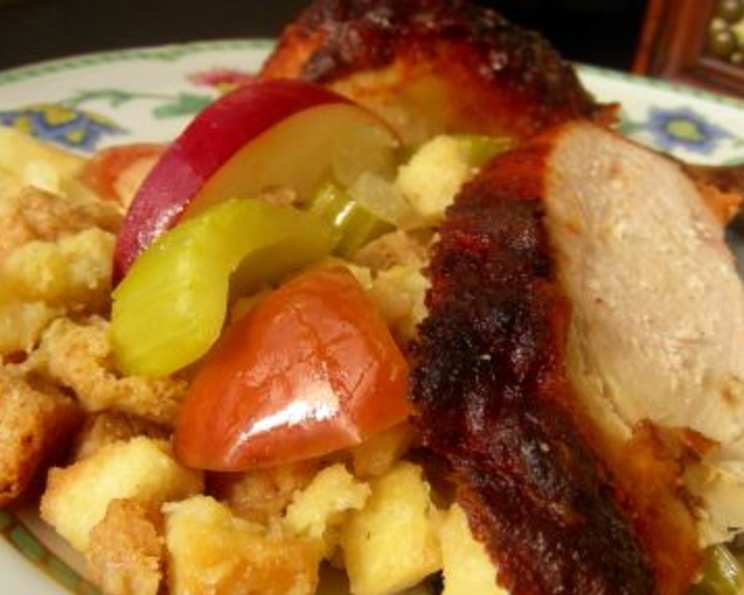
Sunday Roast Chicken With Apple and Herb Stuffing
The aroma of a Sunday roast chicken is forever etched in my memory. As a child, the anticipation would build as the savory scent wafted through the house, a promise of family, comfort, and warmth. My grandmother’s roast chicken was legendary, and while I’ve honed my own techniques over the years, the underlying feeling remains the same: a simple, perfectly cooked bird is pure love on a plate. This version, with its crisp skin, light, juicy apple and herb stuffing, and rich gravy, is a close contender for the gold.
Recipe Overview
- Prep Time: 30 minutes
- Cook Time: 1 hour 50 minutes
- Total Time: 2 hours 20 minutes
- Servings: 4
- Yield: 1 whole chicken
- Dietary Type: Omnivore
Ingredients
- 3-5 sprigs parsley
- 3-5 sprigs thyme
- 1 (3 1/2-4 lb) broiler-fryer chicken, with giblets reserved for stock
- 1/2 lemon, sliced (optional)
- 1/2 onion, sliced (optional)
- 4 tablespoons butter, softened (or margarine)
Apple and Herb Stuffing
- 2 tablespoons butter (or margarine)
- 1 small onion, finely chopped
- 1 cooking apple, peeled, cored, and grated
- 1 cup fresh white breadcrumbs (or whole wheat, rye, etc.)
- 1 small egg, beaten
- 1 tablespoon chopped parsley
- 1 tablespoon chopped fresh thyme
- 1 grated lemon zest
- Salt and black pepper
Gravy
- 2 teaspoons flour
- 1 1/4 cups giblet chicken stock or 1 1/4 cups vegetable stock
Giblet Stock
- Reserved chicken giblets
- 1 quart water
- 1-2 quartered unpeeled onions
- 1 chopped carrot
- 1 chopped celery stalk
- 1 bouquet garni
- Few black peppercorns
Equipment Needed
- Large saucepan or stockpot
- Roasting Pan
- Small ovenproof dish
- Whisk or metal spoon
- Gravy boat
Instructions
- Make the apple and herb stuffing: Melt 2 tablespoons of butter in a saucepan over medium heat. Add the finely chopped onion and cook gently for a few minutes, until softened but not browned. This step is crucial for developing the base flavor of the stuffing.
- Remove the saucepan from the heat and allow it to cool slightly. Stir in the grated apple, breadcrumbs, beaten egg, chopped parsley, chopped thyme, grated lemon zest, and salt and pepper to taste. Ensure all ingredients are well combined.
- Let the stuffing cool completely. This prevents it from partially cooking inside the chicken, which could affect the overall cooking time.
- Prepare the chicken: Place the parsley and thyme sprigs into the cavity of the chicken. Add the sliced lemon and onion, if using, for extra aromatics. Season the cavity with black pepper.
- Truss the chicken, if desired. Trussing helps the chicken cook more evenly and maintains a pleasing shape.
- Spoon the prepared stuffing into the neck end of the chicken. Secure the skin flap over the stuffing with a small skewer to prevent it from spilling out during cooking. Pat the stuffing into a rounded shape.
- If there is any leftover stuffing, put it into a small ovenproof dish. This will bake alongside the chicken.
- Rub the softened 4 tablespoons of butter over the chicken breast. Season the entire chicken with salt and pepper. This helps to create a crispy, golden-brown skin.
- Place the chicken, breast side down, in a roasting pan.
- Cook the chicken: Place the chicken in a preheated 375°F (190°C) oven for about 1 1/2 to 2 hours.
- Turn the chicken over when it is lightly browned, usually after about an hour.
- Continue cooking, basting the chicken with pan juices every 20 minutes. Basting keeps the chicken moist and promotes even browning.
- If you have any leftover stuffing in the ovenproof dish, cook it alongside the chicken for the last 40 minutes of cooking time.
- Test for doneness: Insert a skewer into the thickest part of the thigh. If the juices run clear, the chicken is cooked through. If the juices are pink, continue cooking for a bit longer, checking every 15 minutes.
- Transfer the cooked chicken to a warmed serving platter and keep it warm while you make the gravy.
- Remove the stuffing from the neck cavity and transfer it to a serving dish along with any leftover stuffing that was baked separately.
- Carve the chicken and serve immediately with the gravy.
- Make the gravy: Tilt the roasting pan and spoon off all but 1 tablespoon of the fat that rises to the surface, leaving behind the flavorful cooking juices.
- Place the roasting pan on top of the stove over medium heat. Add 2 teaspoons of flour and cook for 1-2 minutes, stirring constantly with a whisk or metal spoon. This creates a roux, which will thicken the gravy. Be sure to scrape up any browned bits from the bottom of the pan – these add tons of flavor!
- Gradually pour in the 1 1/4 cups of chicken or vegetable stock and bring to a boil, stirring constantly until the gravy thickens.
- Simmer for 2 minutes, then taste and adjust seasoning with salt and pepper as needed.
- Strain the gravy into a warmed gravy boat and serve immediately. This step is optional but yields a smoother gravy.
- Prepare Giblet Stock (Optional): In a stockpot or large saucepan, cook the giblets until lightly browned.
- Stir in 1 quart of water.
- Bring to a boil, skimming off any scum that forms on the surface. Skimming ensures a clear, flavorful stock.
- Add 1-2 quartered unpeeled onions, 1 chopped carrot, 1 chopped celery stalk, 1 bouquet garni, and a few black peppercorns.
- Simmer for about 1 hour.
- Cool, cover, and keep in the fridge for up to 3 days or freeze for up to 3 months.
- Strain before use.
Expert Tips & Tricks
- For extra crispy skin, pat the chicken dry with paper towels before rubbing with butter. Moisture is the enemy of crispy skin!
- If the chicken breast is browning too quickly, loosely tent it with foil during the latter part of the cooking time.
- Adding a splash of white wine to the gravy adds another layer of complexity. Deglaze the pan with the wine before adding the stock.
- Don’t overcrowd the roasting pan. Overcrowding can steam the chicken instead of roasting it.
Serving & Storage Suggestions
Serve the roast chicken immediately after carving, accompanied by the apple and herb stuffing and rich gravy. Classic side dishes include roasted vegetables (potatoes, carrots, parsnips), mashed potatoes, or green beans.
Leftover roast chicken can be stored in an airtight container in the refrigerator for up to 3-4 days. Leftover stuffing should also be stored in an airtight container and refrigerated. Gravy can be refrigerated in a separate container.
To reheat, slice the chicken and heat gently in a skillet with a little chicken broth or gravy to prevent it from drying out. Reheat the stuffing in the oven or microwave. Reheat the gravy on the stovetop or in the microwave, stirring occasionally.
Nutritional Information
| Nutrient | Amount per Serving | % Daily Value |
|---|---|---|
| Calories | 1108.6 kcal | N/A |
| Calories from Fat | 714 g | 64% |
| Total Fat | 79.4 g | 122% |
| Saturated Fat | 28.7 g | 143% |
| Cholesterol | 385.1 mg | 128% |
| Sodium | 599.5 mg | 24% |
| Total Carbohydrate | 16.2 g | 5% |
| Dietary Fiber | 1.5 g | 6% |
| Sugars | 6.1 g | N/A |
| Protein | 78.5 g | 156% |
Note: Nutritional information is an estimate and may vary based on specific ingredients and portion sizes.
Variations & Substitutions
- Gluten-Free: Use gluten-free breadcrumbs for the stuffing and a gluten-free flour blend for the gravy.
- Dairy-Free: Substitute margarine for the butter and use vegetable stock for the gravy.
- Different Herbs: Experiment with other herbs in the stuffing, such as sage, rosemary, or chives.
- Citrus Variations: Use orange zest instead of lemon zest in the stuffing for a different flavor profile.
- Seasonal Apples: Use different varieties of apples depending on the season. Honeycrisp, Gala, or Fuji apples are all good choices.
FAQs (Frequently Asked Questions)
Q: Can I make the stuffing ahead of time?
A: Yes, you can prepare the stuffing a day in advance. Store it in an airtight container in the refrigerator until ready to use.
Q: How do I prevent the chicken from drying out?
A: Basting the chicken regularly with pan juices is key to keeping it moist. You can also tent it with foil if it starts to brown too quickly.
Q: What if I don’t have giblets for the stock?
A: You can use chicken broth or vegetable stock as a substitute. The giblet stock adds depth of flavor, but it’s not essential.
Q: How do I know when the chicken is fully cooked?
A: The best way to check for doneness is to insert a skewer into the thigh. If the juices run clear, the chicken is cooked. You can also use a meat thermometer; the internal temperature should reach 165°F (74°C).
Q: Can I freeze leftover roast chicken?
A: Yes, you can freeze leftover roast chicken. Allow it to cool completely, then wrap it tightly in freezer wrap or place it in a freezer-safe container. It can be frozen for up to 2-3 months.
Final Thoughts
There’s a certain magic to a Sunday roast chicken. It’s more than just a meal; it’s an experience. The comforting aromas, the golden-brown skin, the juicy meat, and the flavorful stuffing all come together to create a dish that is both satisfying and memorable. I encourage you to try this recipe and create your own memories around this classic dish. Don’t be afraid to experiment with different herbs or apple varieties to make it your own. And if you do, please share your feedback – I’d love to hear about your Sunday roast chicken success! Pair it with a crisp Sauvignon Blanc for a truly delightful experience.