
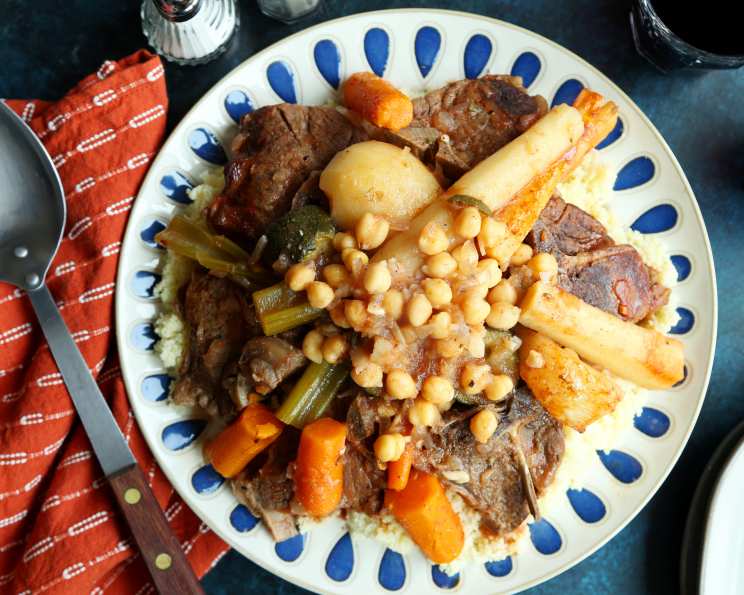
Traditional North African Couscous (The Real Way!)
The scent alone transports me back to my Aunt Fatima’s kitchen in Algiers. The warm aroma of spices mingling with softly steaming couscous filled the air, a promise of the feast to come. We’d gather around a massive table, a kaleidoscope of cousins, uncles, and grandparents, all eager to share stories and laughter over this quintessential dish. It wasn’t just a meal; it was a connection to our heritage, a taste of home in every fluffy grain.
Recipe Overview
- Prep Time: 30 minutes
- Cook Time: 1 hour 55 minutes
- Total Time: 2 hours 25 minutes
- Servings: 8
- Yields: 8 portions
- Dietary Type: Varies (can be adapted to be dairy-free)
Ingredients
- 8 lamb chops or 8 skinless chicken pieces, on bone but skin & fat free if possible
- 1 large onion
- 3 garlic cloves
- 2 medium carrots
- 2 medium courgettes (zucchini)
- 2 large potatoes
- 1/4 swede or 1/4 turnip
- 1 parsnip
- 2-3 stalks celery (or khorchef)
- 1 cup chickpeas, drained
- 2 teaspoons ras el hanout spice mix
- Salt & pepper to taste
- 1 pinch dried mint
- 1/2 tablespoon sunflower oil or 1/2 tablespoon vegetable oil
- 1 cup of tinned plum tomato, liquidised
- 1 1/2 liters water
- 1 large green chili pepper (the Algerian ones) (optional)
- 500 g medium couscous
- 1 tablespoon ghee (smen)
- 1 1/2 tablespoons margarine
- 1 glass water
- Olive oil
Equipment Needed
- Large heavy-bottomed pan or pressure cooker or large cast iron casserole
- Couscousier or steamer
- Large bowl (gas’a optional)
Instructions
-
Begin by preparing the base of the stew. Finely chop the onion and mince the garlic. Place them in a large heavy-bottomed pan with the lamb chops or chicken pieces, ras el hanout, and a little olive oil. Fry gently to seal the meat/chicken. A pressure cooker or large cast iron casserole works well for this step.
-
Prepare the vegetables. Chop the carrot, parsnip, and courgette into sixths. Cut the potato into quarters and roughly chop the swede or turnip. Chop the khorchef or celery into roughly the same size as the carrot. Remember to peel the carrots, potatoes, parsnip, and swede.
-
Add the vegetables to the meat mixture along with 1 liter of water. Turn up the heat until the mixture begins to simmer. If using the chili, add it now, along with salt and pepper.
-
Cooking times will vary depending on your chosen method. If cooking in a regular pan, cook for 40 minutes at a simmer. If using a pressure cooker, 20 minutes will suffice.
-
Add the liquidized tomatoes, chickpeas, and dried mint to the pan, along with 1/2 liter more water, or enough to create a ‘stew’ consistency.
-
Return the pot to the heat and cook for a further 30 minutes in a regular pan, or 25 minutes on medium-high heat in a pressure cooker.
-
While the stew simmers, prepare the couscous. Pour the 500g pack of medium couscous into a gas’a, if you have one. Otherwise, find the largest bowl available. Pick out any ‘bits’.
-
Sprinkle about 50ml of water and a teaspoon of salt over the couscous. Using your hand, rub 1/2 teaspoon of oil through the couscous to stop it from sticking together.
-
Fill a couscousier or steamer halfway with the couscous (as it swells).
-
When you first notice steam coming from the couscous, count 10 minutes. After that, remove the couscous from the steamer, place it back in the gas’a (or bowl), and use your hands to ‘open’ the couscous. This involves rubbing it together between your hands to remove any clumps. This is quite hot, so you will need to keep wetting your hands with cold water and sprinkling a little water on the couscous.
-
Return the couscous to the steamer when thoroughly opened. Repeat the process of steaming and opening twice more.
-
Finally, remove the couscous from the steamer and place it back in the gas’a. Open it for the final time and rub a tablespoon of ghee or smen into the couscous, along with 1 1/2 tablespoons of margarine. Add salt to taste.
-
Serve the couscous in the gas’a with the stew on top in the traditional style, or in a tagine. Usually, the meat/chicken is placed in the center – one piece for each guest – and the couscous is decorated with the vegetables before ladling some of the sauce over the top.
-
If you used the chili, put it on a separate plate and let people help themselves!
Expert Tips & Tricks
- Don’t skip the steaming! This process is crucial for achieving the light and fluffy texture characteristic of authentic couscous.
- Taste as you go! Adjust the salt and pepper levels throughout the cooking process to suit your preference. The ras el hanout spice mix can vary in intensity, so season accordingly.
- For a richer flavor, use bone-in lamb or chicken. The bones release collagen during cooking, adding depth to the stew.
- If you don’t have a couscousier, you can use a colander lined with cheesecloth set over a pot of simmering water.
- To save time, you can use pre-cooked chickpeas, but be sure to rinse them well before adding them to the stew.
Serving & Storage Suggestions
Serve the couscous immediately after cooking for the best texture and flavor. The traditional presentation involves mounding the couscous on a large serving platter, arranging the meat and vegetables artfully on top, and then ladling the stew over the entire dish.
Leftovers can be stored in an airtight container in the refrigerator for up to 3 days. Reheat gently on the stovetop or in the microwave. You may need to add a little water to the couscous to prevent it from drying out during reheating.
While couscous can be frozen, its texture may change slightly upon thawing. If you plan to freeze leftovers, allow the couscous and stew to cool completely before transferring them to freezer-safe containers. They can be stored in the freezer for up to 2 months. Thaw overnight in the refrigerator before reheating.
Nutritional Information
| Nutrient | Amount per Serving | % Daily Value |
|---|---|---|
| Calories | 710.5 kcal | N/A |
| Calories from Fat | 279 g | 39% |
| Total Fat | 31 g | 47% |
| Saturated Fat | 12.9 g | 64% |
| Cholesterol | 74.4 mg | 24% |
| Sodium | 213.1 mg | 8% |
| Total Carbohydrate | 78.6 g | 26% |
| Dietary Fiber | 8.5 g | 33% |
| Sugars | 4.9 g | N/A |
| Protein | 28.3 g | 56% |
Variations & Substitutions
- Vegetarian Couscous: Omit the meat or chicken and substitute with more vegetables, such as butternut squash, sweet potatoes, or eggplant. Consider adding vegetable broth for extra flavor.
- Gluten-Free Couscous: While traditional couscous is made from semolina (wheat), you can find gluten-free couscous made from corn or rice.
- Spicy Couscous: Add a pinch of cayenne pepper or a dash of harissa paste to the stew for an extra kick.
- Herby Couscous: Add chopped fresh herbs, such as parsley, cilantro, or mint, to the couscous just before serving for a burst of freshness.
- Regional Variations: Adapt the vegetables to reflect what’s in season or locally available. Consider adding dried fruits like raisins or apricots for a touch of sweetness, common in some Moroccan versions.
FAQs (Frequently Asked Questions)
Q: Why is it important to steam the couscous multiple times?
A: The multiple steaming process ensures that the couscous is evenly cooked and has a light, fluffy texture. Each steaming plumps the grains, while the “opening” process prevents clumping.
Q: Can I use instant couscous for this recipe?
A: While you can use instant couscous, it won’t have the same texture or flavor as traditionally steamed couscous. The result won’t be the “real way” to prepare this dish, and it will lack the authentic taste.
Q: What is Ras el Hanout?
A: Ras el Hanout is a complex and aromatic spice blend common in North African cuisine. It typically includes a combination of spices such as cardamom, cumin, cloves, cinnamon, nutmeg, and more.
Q: Can I make this recipe ahead of time?
A: The stew can be made a day or two in advance and stored in the refrigerator. However, the couscous is best made fresh just before serving for optimal texture.
Q: What if I don’t have ghee (smen)?
A: If you don’t have ghee (smen), you can substitute with butter. Smen has a slightly fermented flavor, so the taste will be slightly different.
Final Thoughts
This traditional North African couscous is more than just a recipe; it’s an invitation to experience the rich flavors and cultural heritage of the region. Don’t be intimidated by the multiple steaming steps; the result is well worth the effort. Gather your loved ones, share stories, and savor the warmth and comfort of this timeless dish. I encourage you to give it a try, and I’d love to hear about your experience and any personal touches you add to make it your own! Consider pairing it with a refreshing mint tea to complete the meal.