
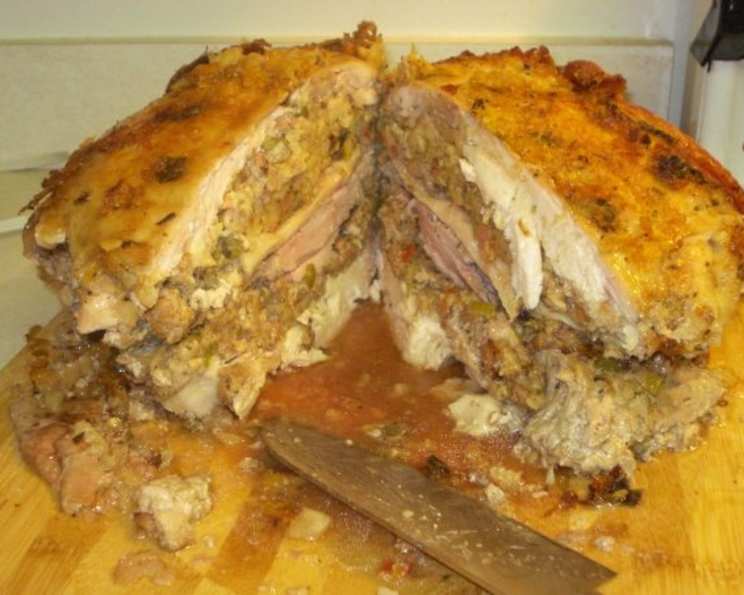
Turducken: Moist and Flavorful Good Eats!
I’ll never forget the Thanksgiving my Aunt Carol attempted a Turducken for the first time. The anticipation was palpable, the aroma intoxicating, but the carving? Utter chaos! Slices tumbled apart, stuffing oozed, and everyone erupted in laughter. Despite the slightly mangled presentation, the taste was phenomenal – a harmonious blend of textures and savory flavors I’ve craved ever since. It’s a dish that truly embodies the spirit of celebration, a testament to culinary ambition, and a guaranteed conversation starter.
Recipe Overview
- Prep Time: Varies depending on deboning – minimum 2 hours
- Cook Time: 9 1/2 hours
- Total Time: 11 hours
- Servings: 25
- Yield: 1 Turducken
- Dietary Type: Not specified, high in fat and protein
Ingredients
Brine:
- 1 cup coarse salt or 1 cup pickling salt
- 1 cup sugar
- 2 quarts apple juice
- 10 peppercorns
- 2 bay leaves
- 10 fresh sage leaves
- 4 sprigs fresh rosemary
- 10 garlic cloves
Turducken:
- 18-20 lbs whole turkey
- 4-5 lbs whole ducklings
- 3-4 lbs whole chickens (or use a larger chicken and place the duckling inside it)
- 2-4 cups prepared stuffing (your favorite sausage stuffing – sweet and spicy sausage is recommended)
- 12 ounces beer
- 8 tablespoons butter, melted
- Fresh herbs (sage, parsley, thyme, rosemary)
- Paprika, to taste
- Salt, to taste
- Pepper, to taste
- 12 ounces crushed pineapple (optional)
Equipment Needed
- Very large stainless steel pot
- Kitchen shears or sharp boning knife
- Cotton thread and needle
- Roasting rack
- Large roasting pan
- Meat thermometer
Instructions
- Brining the Birds: The day before serving, mix the salt, sugar, apple juice, peppercorns, bay leaves, sage leaves, rosemary, and garlic cloves in a very large stainless steel pot. Add about 2 dozen ice cubes to cool the brine and set aside.
- De-boning the Birds: This is the most time-consuming part. Rinse the turkey, ducklings, and chickens. Remove the necks and any giblets, saving them for stock.
- De-boning the Turkey: Place the turkey, breast side down, on a clean flat surface. Using a pair of kitchen shears or a sharp boning knife, cut the backbone from the turkey. It’s helpful to leave about 2 inches of backbone near the bottom of the spine for support.
- Using the tip of a knife and starting from the neck end, gently separate meat from rib cage on one side. Be careful not to cut through the breast skin. Cut through the meat to expose the shoulder blade; cut meat away from and around the bone, severing bone at the joint to remove shoulder blade.
- Disjoint wing between second and third joints. Leave the wing bones and keep the wing attached to the meat. Continue separating meat from frame, working toward the thighbone and being careful to keep the “oyster” (pocket of meat on back) attached to skin, rather than leaving it with the bone. Cut through ball-and-socket joint to release the thighbone from the carcass (bird will be open on one side). Keep the leg attached to the meat.
- Repeat boning procedure on the other side of the turkey. Carefully remove the carcass and use it to make stock for your gravy. You should end up with a flat boneless (except for wings and legs) turkey with the skin intact in one large piece. Rinse and put the boned turkey in the brine.
- De-boning the Duck and Chicken: Repeat the deboning process on the duck and the chicken, but debone both stumps of wings and leg drumsticks. Cut through flesh at the thinnest point and trim around these bones with a knife until they can be removed. (Since they have little meat, you can cut off the entire wings and add them to the stock pot.) Both the chicken and duck will be stuffed inside the turkey and need not be kept “perfectly” intact.
- Trim skin and fat from the birds. Ducks, in particular, have a lot of excess fatty skin that should be saved to render fat to be used for other recipes. Remove all the skin from the chicken and duck as they don’t crisp up and give it a mushy texture and mouth feel. Add the chicken and duck to the brine, adding ice cold water to completely cover. Place top on and chill until the morning.
- Assembling the Turducken: At least 11 hours before dinner, assemble the Turducken. Rinse and dry the turkey, duck, and chicken. Spread the turkey, skin down, on a flat surface, exposing as much meat as possible.
- Spread some of your prepared stuffing (about 3/4 inch thick) over the turkey in an even layer.
- Place the duck on top of the stuffing. Spread more stuffing in an even layer over the duck.
- Arrange the chicken over the stuffing.
- You’ll need someone to hold the birds closed while you sew up the seam. Carefully lift the sides of the layered birds, folding the sides of the turkey together. Using cotton thread and a needle, sew the seam going through some of the chicken and turkey skin.
- Since the turducken has no skeleton, it must be trussed up or it may fall apart in cooking. Tie 4-5 pieces of cotton string around the bird width-wise to act as skeletal support.
- Turn the bird over and place in a roasting rack inside a large roasting pan so it is breast side up and looks like a “normal” turkey.
- Tie the legs together just above the tip bones. Secure the wings close to the body.
- Mix fresh herbs of your choice (sage, parsley, thyme, rosemary) in melted butter.
- Pour the butter mixture over the turkey. Generously season with pepper, salt, and paprika.
- Pour the beer into the pan.
- Cooking the Turducken: Preheat the oven to 225 degrees F.
- Place the bird on a rack in a roasting pan in the center of the oven and bake for 3 hours. Baste the bird. After 6 hours, pour the crushed pineapple (if using) over the turkey and continue baking until a meat thermometer inserted through to center reads 165 degrees F, approximately 9 1/2 hours total, though cooking times will vary depending on the size of the birds and amount of stuffing used.
- Save pan drippings for an amazing gravy.
- Remove the turducken from the oven and let rest in the pan for an 1/2 hour before serving. Meanwhile, make gravy as you like using the drippings.
- Serving: To serve, cut the bird in half. Carve crosswise so each slice reveals all 3 meats and the stuffing.
Expert Tips & Tricks
- Don’t skip the brining! It’s crucial for keeping the birds moist during the long cooking time.
- Deboning can be tricky. If you’re not confident, ask your butcher to debone the birds for you.
- Use a variety of stuffing. Different flavors and textures will make each bite interesting. Consider a cornbread stuffing, a wild rice stuffing, or a fruit-based stuffing in addition to the sausage stuffing.
- Monitor the internal temperature closely. Using a reliable meat thermometer is essential to ensure the turducken is cooked through but not overcooked.
- If the top of the turducken starts to brown too much during cooking, tent it with foil.
Serving & Storage Suggestions
Serve the turducken hot, carved crosswise to showcase the layers of meat and stuffing. Garnish with fresh herbs. The pan drippings make an excellent gravy. Leftovers should be cooled completely and stored in an airtight container in the refrigerator for up to 3-4 days, or in the freezer for up to 2 months. Reheat gently in the oven or microwave.
Nutritional Information
| Nutrient | Amount per Serving | % Daily Value |
|---|---|---|
| Calories | 741.5 kcal | N/A |
| Calories from Fat | 340 g | 46% |
| Total Fat | 37.8 g | 58% |
| Saturated Fat | 11.8 g | 58% |
| Cholesterol | 296.8 mg | 98% |
| Sodium | 4887.6 mg | 203% |
| Total Carbohydrate | 21.4 g | 7% |
| Dietary Fiber | 0.7 g | 2% |
| Sugars | 16 g | 63% |
| Protein | 73.4 g | 146% |
Variations & Substitutions
- Spice it up: Add a pinch of cayenne pepper to the stuffing for a little heat.
- Use different proteins: Substitute pheasant or quail for the chicken or duck.
- Experiment with stuffing: Use a bread-based stuffing, a rice-based stuffing, or a combination of both. Add dried cranberries, chopped nuts, or sautéed mushrooms.
- Vegetarian Turducken: A vegetarian version could be made by layering stuffed portobello mushrooms, eggplant slices, and butternut squash.
- Regional Variations: Use Andouille sausage and Cajun spices for a Louisiana-style Turducken.
FAQs (Frequently Asked Questions)
Q: Is de-boning the birds really necessary?
A: Yes, to create the layered effect and ensure even cooking, the birds need to be de-boned. It also makes carving much easier.
Q: Can I make the stuffing ahead of time?
A: Absolutely! Making the stuffing a day or two in advance saves time on the day of assembly.
Q: How do I know when the Turducken is done?
A: A meat thermometer inserted into the thickest part of the Turducken should read 165 degrees F (74 degrees C).
Q: What if I don’t like beer? Can I use something else in the pan?
A: Chicken broth or apple cider are good substitutes for beer. They will add moisture and flavor.
Q: Can I freeze the leftovers?
A: Yes, wrap leftovers tightly in freezer-safe packaging and freeze for up to 2 months.
Final Thoughts
The Turducken is a labor of love, a show-stopping centerpiece that’s sure to impress your guests. Don’t be intimidated by the process – with a little patience and attention to detail, you can create a memorable dish that will become a holiday tradition. So gather your ingredients, sharpen your knives, and embark on this culinary adventure! Be sure to share your Turducken triumphs (and maybe a few hilarious carving mishaps) with friends and family. Happy cooking!