
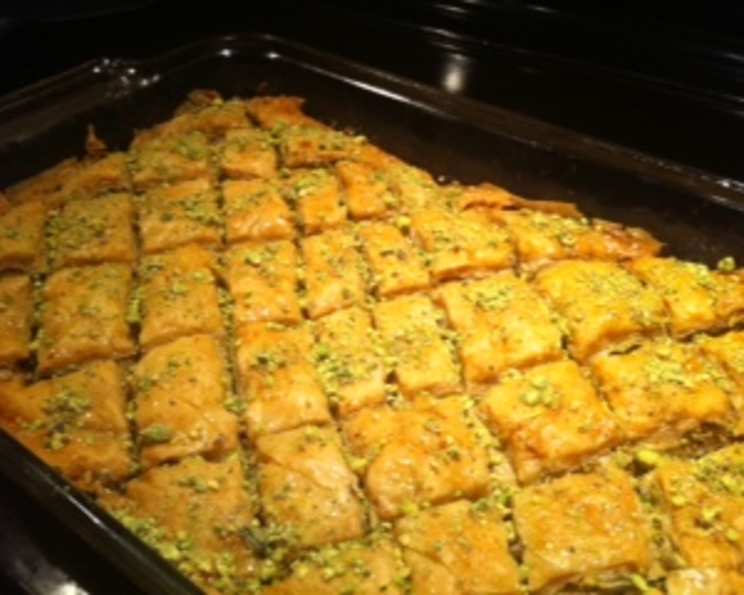
Pistachio Baklava With Cardamom and Rose Water
The memory of my grandmother’s kitchen floods back with every bite of baklava. It wasn’t just the sugary, nutty scent that permeated the air, but the rhythmic sound of her rolling pin across the thin phyllo dough, a sound that meant family, warmth, and an abundance of love was on its way. This Pistachio Baklava, infused with the aromatic blend of cardamom and rose water, is my homage to her, a way to keep those cherished memories alive.
Recipe Overview
- Prep Time: 45 minutes
- Cook Time: 1 hour 30 minutes
- Total Time: 4 hours 15 minutes (includes cooling and resting time)
- Yields: 32 pieces
- Serves: 32
- Dietary Type: Vegetarian
Ingredients
Sugar Syrup
- 1 3/4 cups granulated sugar
- 3/4 cup water
- 1 tablespoon lemon juice
- 10 black peppercorns
- 1/8 teaspoon table salt
- 1 tablespoon rose water
Nut Filling
- 12 ounces raw, shelled pistachios
- 1 teaspoon ground cardamom
- 2 tablespoons granulated sugar
- 1/8 teaspoon table salt
Pastry and Butter
- 1 1/2 cups unsalted butter, clarified, melted and cooled slightly (3 sticks)
- 1 lb frozen phyllo dough, thawed
Equipment Needed
- Small saucepan
- 2-cup measuring cup
- Food processor
- Large bowl
- 13×9 inch baking pan (traditional, not nonstick)
- Large cutting board
- Chef’s knife
- Plastic wrap
- Damp kitchen towel
- Pastry brush
- Bread knife or serrated knife
- Wire rack
Instructions
- Prepare the Sugar Syrup: In a small saucepan, combine the granulated sugar, water, lemon juice, black peppercorns, and salt. Bring the mixture to a full boil over medium-high heat, stirring occasionally to ensure the sugar dissolves completely.
- Cool the Syrup: Once boiling, transfer the syrup to a 2-cup measuring cup. Set aside to cool completely while you prepare the baklava.
- Remove Peppercorns: Once the syrup is cool, discard the black peppercorns.
- Add Rose Water: Stir in the rose water. The cooled syrup can be refrigerated in an airtight container for up to 4 days.
- Prepare the Pistachios: In a food processor, pulse the pistachios until they are very finely chopped. Use short, 1-second pulses to prevent turning them into a paste – about fifteen pulses should do the trick.
- Combine Filling Ingredients: Transfer the chopped pistachios to a bowl. Measure out 1 tablespoon of the nuts and set aside for garnish later.
- Add Flavor to the Filling: To the remaining pistachios, add the ground cardamom, sugar, and salt. Toss well to combine all ingredients thoroughly.
- Clarify the Butter: While not explicitly mentioned in the ingredients, clarifying the butter is an important step. Melt the butter in a saucepan over low heat. Skim off the foamy solids that rise to the top. Carefully pour the clear, golden butter into a separate container, leaving the milky solids at the bottom of the pan. These solids can burn during baking, so removing them is crucial. This clarified butter will provide a richer flavor and flakier texture to the baklava. Allow the clarified butter to cool slightly before using.
- Prepare Phyllo Dough: Brush the 13×9-inch baking pan with the clarified butter making sure it is fully coated to prevent sticking. Adjust the oven rack to the lower-middle position and preheat the oven to 300 degrees Fahrenheit (150 degrees Celsius).
- Unwrap and Cut Phyllo: Unwrap and unfold the phyllo dough on a large cutting board. Carefully smooth the sheets with your hands to flatten them.
- Cut Phyllo to Size: Using the baking pan as a guide, cut the phyllo sheets crosswise with a chef’s knife, yielding two roughly evenly sized stacks of phyllo. Don’t worry if the stacks are not perfectly even; one may be slightly narrower than the other.
- Prevent Dough From Drying: Cover the phyllo stacks with plastic wrap, then a damp kitchen towel to prevent them from drying out while you assemble the baklava. Dry phyllo is brittle and difficult to work with.
- Begin Layering Phyllo: Place one phyllo sheet (from the wider stack) in the bottom of the buttered baking pan and brush it completely with clarified butter.
- Repeat Bottom Layers: Repeat with 7 more phyllo sheets (from the wider stack), brushing each sheet generously with clarified butter before adding the next.
- Add First Nut Layer: Evenly distribute about 1 cup of the pistachio mixture over the phyllo layer.
- Layer More Phyllo: Cover the nuts with one phyllo sheet (from the narrower stack) and dab it lightly with butter (brushing may cause the phyllo to slip).
- Repeat Middle Phyllo Layers: Repeat with 5 more phyllo sheets (from the narrower stack), staggering the sheets slightly if necessary to completely cover the nuts. Brush each sheet with clarified butter.
- Add Second Nut Layer: Repeat the layering process with an additional 1 cup of nuts.
- More Phyllo Layers: Cover the nut layer with 6 sheets of phyllo, staggering sheets slightly if necessary to cover the nuts, and brushing each with clarified butter.
- Add Final Nut Layer: Repeat the layering process with the remaining 1 cup of nuts.
- Final Phyllo Layers: Finish with 8 to 10 sheets of phyllo (from the wider stack), using the nicest and most intact sheets for the uppermost layers. Brush each sheet with clarified butter, except for the final sheet.
- Compress Layers: Use the palms of your hands to gently compress the layers, working from the center outward to press out any air pockets. This helps the baklava hold its shape and prevents it from puffing up too much during baking.
- Brush Top With Butter: Spoon 4 tablespoons of clarified butter on the top layer and brush it evenly to cover all surfaces. This gives the baklava a beautiful golden-brown color.
- Cut Into Diamonds: Use a bread knife or other serrated knife with a pointed tip in a gentle sawing motion to cut the baklava into diamonds. Cut on the bias into eighths on both diagonals. The pre-cut allows the syrup to penetrate all layers of the baklava.
- Bake: Bake until golden and crisped, about 1 ½ hours, rotating the baking pan halfway through baking to ensure even browning. Watch carefully; baking times can vary depending on your oven.
- Pour Syrup: Immediately after removing the baklava from the oven, pour the cooled syrup over the cut lines until about 2 tablespoons remain (the syrup will sizzle when it hits the hot pan). Drizzle the remaining syrup evenly over the surface.
- Garnish: Garnish the center of each piece with a pinch of the reserved ground pistachios.
- Cool and Rest: Cool the baklava to room temperature on a wire rack, about 3 hours. Then, cover it with foil and let it stand for at least 8 hours before serving. The flavor and texture improve significantly as the baklava rests and the syrup is fully absorbed.
Expert Tips & Tricks
- Use High-Quality Pistachios: The flavor of the pistachios is central to this recipe, so opt for the best quality you can find. Look for vibrant green pistachios.
- Don’t Over-Process the Pistachios: Be careful not to over-process the pistachios in the food processor, as this can result in pistachio butter rather than a finely chopped mixture.
- Keep Phyllo Dough Moist: Phyllo dough dries out quickly, so keep it covered with plastic wrap and a damp towel at all times while you are working.
- Be Generous with Butter: The clarified butter is what gives baklava its signature flaky texture. Don’t skimp on it!
- Patience is Key: Baklava is best when allowed to rest for at least 8 hours after baking. This allows the syrup to fully penetrate the layers of phyllo and nuts, resulting in a moist and flavorful dessert.
- Adjust Sweetness: If you prefer a less sweet baklava, you can reduce the amount of sugar in the syrup slightly.
- Make Ahead: Baklava can be made several days in advance and stored at room temperature. In fact, the flavor often improves with time.
Serving & Storage Suggestions
Serve the Pistachio Baklava at room temperature. It is delicious on its own or as a sweet ending to a Mediterranean-inspired meal. To store, wrap the cooled baklava tightly in foil and keep it at room temperature for up to 10 days. While refrigeration is possible, it can soften the phyllo. Freezing is not recommended as it alters the texture.
Nutritional Information
| Nutrient | Amount per Serving | % Daily Value |
|---|---|---|
| Calories | 224.5 kcal | N/A |
| Calories from Fat | 128 g | 57% |
| Total Fat | 14.2 g | 21% |
| Saturated Fat | 6.3 g | 31% |
| Cholesterol | 22.9 mg | 7% |
| Sodium | 133.7 mg | 5% |
| Total Carbohydrate | 22.3 g | 7% |
| Dietary Fiber | 1.4 g | 5% |
| Sugars | 12.6 g | 50% |
| Protein | 3.3 g | 6% |
Note: Nutritional information is an estimate and may vary based on specific ingredients and preparation methods.
Variations & Substitutions
- Other Nuts: Feel free to experiment with other nuts, such as walnuts, almonds, or a combination.
- Citrus Zest: Add a teaspoon of orange or lemon zest to the nut filling for a brighter flavor.
- Honey Syrup: Substitute honey for some of the granulated sugar in the syrup for a richer, more floral flavor.
- Spice Variations: Try adding a pinch of cinnamon or nutmeg to the nut filling along with the cardamom.
- Vegan Option: Use a vegan butter substitute and ensure your phyllo dough is vegan-friendly.
FAQs (Frequently Asked Questions)
Q: Why is my baklava soggy?
A: Soggy baklava is usually caused by using syrup that is too warm or by not allowing the baklava to cool completely before serving. Make sure the syrup is completely cool before pouring it over the hot baklava.
Q: How do I prevent the phyllo dough from drying out?
A: Keep the phyllo dough covered with plastic wrap and a damp towel at all times while you are working with it. This will help to prevent it from drying out and becoming brittle.
Q: Can I make baklava ahead of time?
A: Yes! Baklava is a great make-ahead dessert. In fact, the flavor often improves with time as the syrup fully penetrates the layers.
Q: How do I cut baklava neatly?
A: Use a serrated knife and a gentle sawing motion to cut the baklava. Cutting it before baking helps to create neat and even pieces.
Q: Why did my baklava burn on top but is still not cooked in the middle?
A: Your oven temperature might be too high. Lower the oven temperature by 25 degrees Fahrenheit and tent the baklava with foil to prevent further browning.
Final Thoughts
This Pistachio Baklava, fragrant with cardamom and rose water, is more than just a dessert; it’s an experience. A labor of love that rewards you with its delightful textures and complex flavors. Don’t be intimidated by the many layers; take your time, enjoy the process, and create a memory that will be savored with every bite. I encourage you to try this recipe, to adapt it to your own taste, and to share it with those you love. And, of course, I’d love to hear about your baking adventures – share your feedback and any variations you try! Consider pairing this baklava with a strong cup of Turkish coffee or a glass of sweet dessert wine for the ultimate indulgence.